

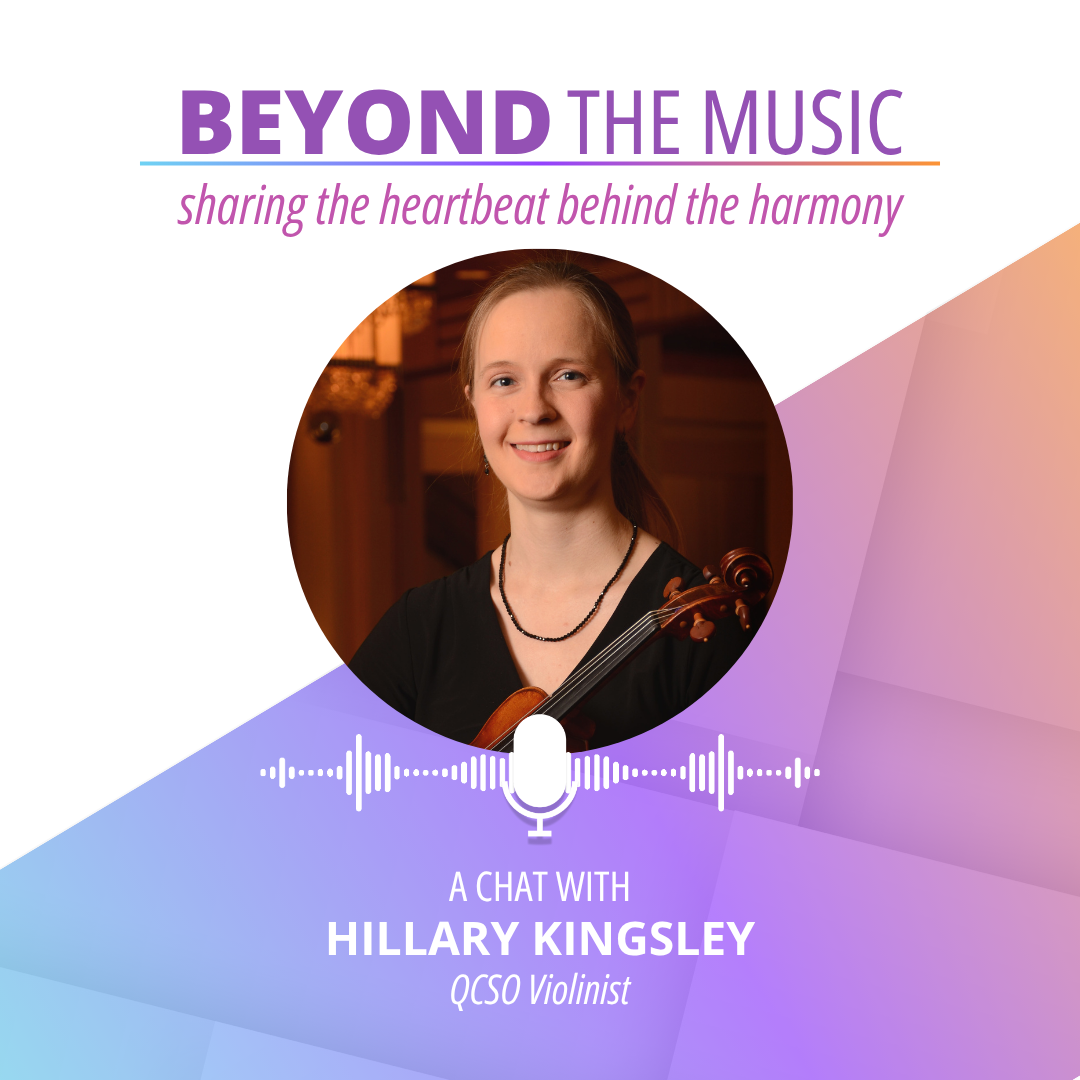
On this episode of Beyond the Music, QCSO Executive Director Brian Baxter sits down with violinist Hilary Kingsley, now in her twelfth season with the Quad City Symphony Orchestra, to discuss her upcoming performance on the Up Close chamber concert at the Figge Art Museum.
Kingsley offers an illuminating look into Steve Reich’s groundbreaking work Different Trains, the centerpiece of the program. She explains how Reich weaves together archival recordings of Holocaust survivors, train sounds, sampled speech, and multiple layers of pre‑recorded string quartets to create a powerful meditation on memory, identity, and the contrasting experiences of Jewish children during World War II. She also shares insights into the technical and emotional challenges of performing live alongside a fixed electronic track.
The conversation expands into the unique artistry of chamber music — the collaborative decision‑making, the heightened individuality of each player, and the interpretive depth required when performing works like Schubert’s Erlkönig, also featured on the program.
Kingsley reflects on the realities of a professional musician’s life, from juggling multiple projects to the discipline of being fully present in each piece she prepares. Her passion for music’s immersive, expressive power shines through.
Join us for a deeper look at the stories, ideas, and artistic process behind this evocative Up Close performance.
TRANSCRIPT:
Brian Baxter:
Welcome to Beyond the Music. I’m so happy to be here with Hilary Kingsley, a member of the Quad City Symphony Orchestra. We were just discussing that you’re finishing your 12th season with the QCSO. Hilary, you’ll be performing on our upcoming Up Close concert. Thanks for joining us.
Hillary Kingsley:
Absolutely — thanks for having me, Brian.
Brian:
This is a special performance. What excites you most about this Up Close concert? Is there a particular piece you’re especially looking forward to sharing with audiences?
Hillary:
Yes — definitely. The focal point of this concert is Different Trains by Steve Reich, and it’s worth talking about this piece a bit because it really benefits from some preparation for the audience.
The Kronos Quartet commissioned the work, and at the time, Reich was fascinated by a new technology in the 1980s: the sampling keyboard. He could record snippets of speech or sound and then use those samples compositionally. He wanted to create a piece for string quartet built around human speech.
Reich grew up as an American Jewish child in the 1940s. His parents lived in New York and Los Angeles, so he traveled back and forth by train — a four‑day trip. He began imagining that if he had been a Jewish child in Europe during World War II, he might have been riding very different trains.
Brian:
Yes.
Hillary:
That’s the emotional core of the piece. Musically, the strings mimic train sounds — this constant chugging motion, especially in the violins. But the most important element is the recorded voices.
Reich sampled:
His governess, describing the train journeys
A railroad porter calling out trains
And most importantly, archival recordings of Holocaust survivors
He takes tiny snippets of their speech — just a few words at a time — and the strings imitate the pitch and rhythm of those spoken phrases. You’ll hear things like “from New York to Los Angeles,” and the viola and cello often carry those speech‑melodies, though it moves around the quartet.
Along with the voices, you’ll hear actual train recordings, whistles, and — this is wild — three additional pre‑recorded string quartets layered on top of us. So it’s this huge, rich texture of live strings plus recorded strings plus voices plus trains. It’s incredibly powerful.
Reich has said he felt it would be presumptuous to speak about the Holocaust without using the voices of people who actually lived through it. So he built the piece around their words.
Brian:
It’s an incredible work. I remember hearing it as a young musician and being blown away. I can’t wait to hear it at the Figge with you all performing alongside the track.
Hillary:
I can’t wait either. It’s exciting — and challenging — to practice with the track. There are many tempo changes, and the recording is completely rigid. It won’t adjust to us, so we have to be absolutely faithful to it. It’s like playing with the world’s strictest metronome.
Brian:
Right — that adds a whole new layer. So this is chamber music, which is what we feature on Up Close. What is it like to play chamber music compared to playing in the full orchestra?
Hillary:
I love it. It’s really fun and really engaging.
In a small group, everything depends on the personalities in the room — and I’m very much looking forward to playing with this group. But unlike the orchestra, there’s no conductor. So we have to decide together: What’s our interpretation? How are we shaping this phrase? Whose idea are we going with this time?
Even practical things like bowings require discussion and agreement.
And because you’re the only person on your part, your individual voice matters so much more. In the orchestra, I’m one of maybe twelve first violins. My job there is to blend, to serve the larger sound. It’s almost militaristic — we’re all aligning to a unified goal.
But in a string quartet, my personal sound, my expressive choices, my sense of color — those things are essential. I have to have convictions about the music.
Brian:
Yes.
Hillary:
For example, we’re also performing a string quartet arrangement of Schubert’s Erlkönig. If people don’t know the song, it’s based on a German folk tale about the Elf King — a spirit who lures children to their deaths. Very dark.
But it’s actually a meaningful pairing with a program centered on the Holocaust. In the song, a father and son ride through the woods, and the quartet imitates the galloping horse. My part often represents the child crying out, “Father, father, the Elf King is behind me!”
So I have to ask: How do I play the child’s fear? How do I play the Elf King’s seduction? What tone color expresses that? It’s not just about playing the notes — it’s about delivering the story.
Brian:
Exactly. It’s the difference between playing the music and saying something with the music.
Hillary:
Yes — completely.
Brian:
Audiences love hearing about how musicians prepare. So here’s our final question: What’s one thing you wish people understood more about the life of a professional musician?
Hillary:
There are so many things, but here’s what comes to mind — especially in this busy March and April season: we’re constantly being pulled in a million directions.
Right now I’m preparing:
This Up Close concert
Mahler 6 for Masterworks 6
Another orchestra concert later in the season
Church music for Easter
Lessons for my students
And trying to plan a vacation
But when I sit down to practice Schubert, I have to be fully present with Schubert. When I’m practicing Different Trains, I have to be fully in that world. You can’t practice while thinking about the next ten things on your list.
And that’s one of the things I love most about music — it demands complete presence. It engages every part of your brain. The more present you are, the more powerful the performance.
Brian:
Absolutely. That’s one of the gifts of music — for performers and listeners. Well, thank you so much for joining us. We’re looking forward to the concert on April 18 at the Figge Art Museum.
Hillary:
Absolutely. Thanks for having me, Brian.
Brian:
Thanks for joining us.
Beyond the Music: sharing the heartbeat behind the harmony
Beyond the Music: Sharing the Heartbeat behind the Harmony takes you behind the scenes of the Quad City Symphony Orchestra to meet the musicians, staff, and community members who bring the music to life.
Through candid conversations and personal stories, this series explores the passion, people, and purpose that drive every performance, giving you a deeper connection to the symphony and the harmony it creates both on and off the stage.