


PROGRAM NOTES
ARTIST BIOGRAPHIES
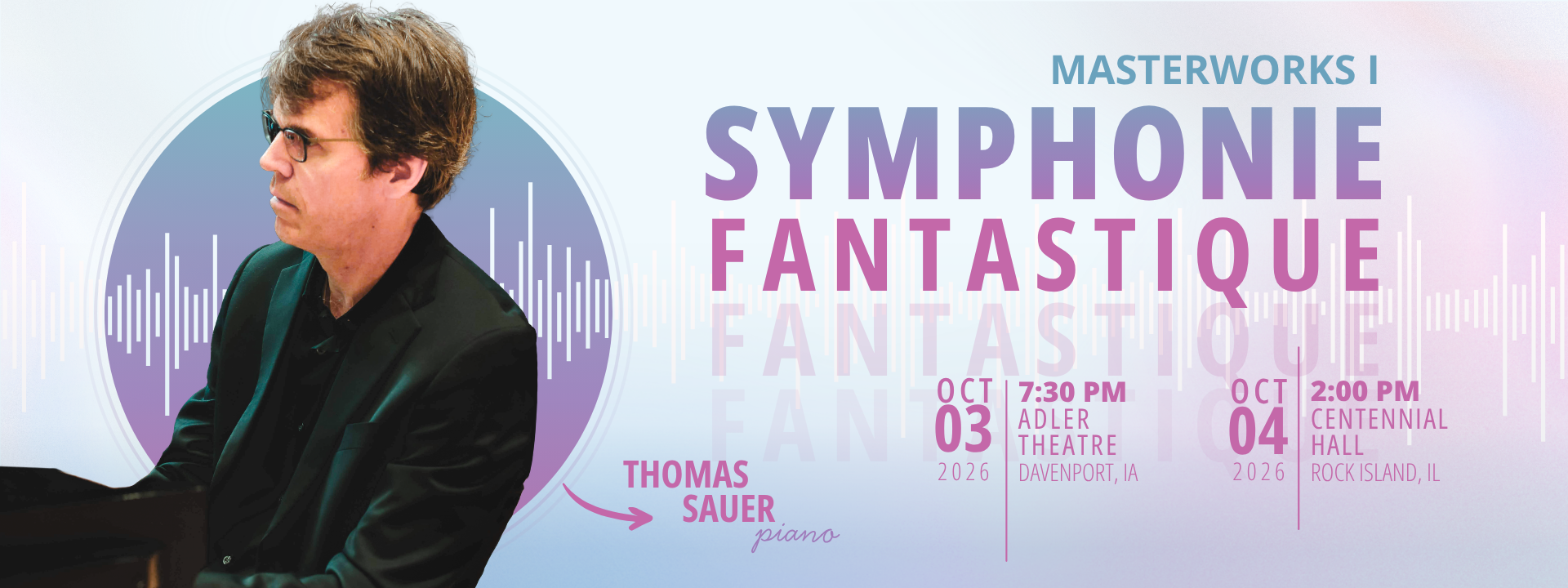
Thomas Sauer, piano
Davenport native Thomas Sauer performs regularly as soloist, chamber musician, and recital partner. His large and varied repertoire encompasses Bach to the present day. Audiences and critics alike praise his playing for its clarity, expressivity, and assured stylistic sense. Some of Mr. Sauer’s recent solo appearances include concertos with the Quad-City and Tallahassee Symphonies, the Greenwich Village Orchestra, and recitals at Mannes, Simon’s Rock, and Vassar Colleges, Merkin Concert Hall, Rockefeller University, and St. John’s College, Oxford.
With his long-time duo partner, English cellist Colin Carr, Mr. Sauer has appeared at the Wigmore Hall (London), the Amsterdam Concertgebouw and Muziekgebouw, and the Isabella Stewart Gardner Museum (Boston). Other duo recitals include violinists Midori (Berlin Philharmonie and Brussels’ Palais des Beaux Arts) and Jennifer Koh (Kennedy Center, Kimmel Center, Library of Congress, Princeton University).
Among Mr. Sauer’s numerous chamber music appearances are performances at the Chamber Music Societies of Lincoln Center, Boston and Philadelphia; and numerous concerts with the Brentano String Quartet. Mr. Sauer has performed at many of the leading festivals in the United States and abroad, including Marlboro, Caramoor, Music@Menlo, Chamber Music Northwest, El Paso Pro Musica, and the Chamber Music Festivals of Seattle, Taos, Four Seasons (North Carolina), Portland, and Salt Bay (Maine); as well as Lake District Summer Music (England) and Festival des Consonances (France). He has premiered works by Robert Cuckson, Sebastian Currier, Tania León, Donald Martino, Harold Meltzer, Ruth Schonthal, Nathan Shields, Suzanne Sorkin, and Richard Wilson, among many others.
A committed teacher, with students at Mannes College, Vassar College, and the Graduate Center of the City University of New York, Mr. Sauer was the founder and director of the Mannes Beethoven Institute, a highly-regarded week-long summer training program that ran for fifteen seasons in New York.
PROGRAM NOTES
written by Jacob Bancks,
Professor of Music, Augustana College
ANTONÍN DVOŘÂK • Carnival Overture in A major, Op. 92
ANTONÍN DVOŘÂK
(1841-1904)

INSTRUMENTATION:
2 flutes, piccolo, 2 oboes, 1 English horn, 2 clarinets, 2 bassoons, 4 horns, 2 trumpets, 3 trombones, tuba, timpani, percussion (triangle, cymbals, tambourine), harp, and strings
PREMIERE:
April 28, 1892, Prague National Theatre Orchestra (the composer conducting), Rudolfinum Concert Hall, Prague
QCSO PERFORMANCE HISTORY:
1931 (Ludwig Becker); 1936 (Frank Laird Waller); 1947 (Oscar Anderson); 1971, 1981, 1989 (James Dixon); 2011 (Mark Russell Smith)
Take all of the extramusical topics treated by symphonic composers in the nineteenth century, and certain themes emerge again and again: nature (Beethoven’s Pastorale, Smetana’s Moldau), life (Strauss’s Ein Heldenleben, Liszt’s Les Préludes), and of course, love (with no finer example than Berlioz’s Symphonie fantastique). These broad topics were also, unsurprisingly, the preoccupation of romantic philosophers, poets, and novelists, who shared with their composer peers a keen interest in the psychology of human experience and its interaction with the natural world.
Thus when Antonín Dvořák composed a trilogy of concert overtures in 1891, he decided to write one each on nature, life, and love. Between In Nature’s Realm (nature) and Othello (love) was the effervescent Carnival Overture, a celebratory and exuberant exploration of the joys of life. This central work has gone on to become one of Dvořák’s most often performed works. The other two, along with Dvořák’s other programmatic symphonic music, have unfortunately suffered a bit in obscurity, being overshadowed by the mass popularity of his symphonies.
Of particular interest to American audiences is the place of the Carnival Overture in Dvořák’s biography; shortly after its premiere, he embarked on his first journey to the United States to serve at the newly formed National Conservatory of Music in America. At work on this cheerful orchestral work, the composer seems to have approached his upcoming transatlantic journey with general optimism and an open mind. “The things people tell you about America don’t amount to much. They are always for or against,” he wrote in a letter. “That’s how it is in the world.”
LISTENING GUIDE
Timbre:
Dvořák makes liberal use of “festival” percussion instruments, the tambourine and triangle, in this overture’s outer sections. Note the variety of rhythms and techniques, particularly in the tambourine.Rhythm:
Compared to the exuberant opening, the second main theme in this overture is more drawn-out and expressively passionate. However, under this sweeping melody, Dvořák sustains the rhythmic excitement with subdued but insistent accompaniment.Form:
The harp signals the beginning of the “second quarter” of the overture, where Dvořák relaxes the intensity, slows the tempo, and features several elegant solos, including one for solo violin.Melody:
Notice that, underneath the elongated instrumental solos, the English horn plays an “ostinato,” a melodic figure repeated many times consecutively. “Ostinato” is Italian for “obstinate” – the motive literally refuses to change.Harmony:
The overture’s “third quarter” is akin to the development section in a symphony, where the motives and rhythmic energy of the opening return but in an unstable harmonic environment. The tunes feel familiar but the shifts in key and minor mode are disorienting (not an unfamiliar sensation at a carnival).Rhythm:
Dvořák heightens the tension and excitement at the piece’s conclusion with ever-increasing tempos, making the now-familiar motives ever more frenetic and exciting.
LUDWIG VAN BEETHOVEN • Piano Concerto No. 4 in G major, Op. 58
LUDWIG VAN BEETHOVEN
(1770-1827)
INSTRUMENTATION:
1 flute, 2 oboes, 2 clarinets, 2 bassoons, 2 horns, 2 trumpets, timpani, solo piano, and stringsPREMIERE:
December 22, 1808, Theater an der Wien (the composer as soloist and conductor). The composer premiered the work in a private performance in the palace of Prince Lobkowitz in March 1807.QCSO PERFORMANCE HISTORY:
A remarkable number of highly prominent pianists have performed this concerto over QCSO history. 1940 (Robert Casadesus/Oscar Anderson), 1960 (Eugene Istomin/Charles Gigante), 1985 (Misha Dichter/James Dixon), 1994 (Susan Starr/Leslie Dunner), 2009 (Louis Schwizgebel/Mark Russell Smith)
When the baroque flute virtuoso Johann Joachim Quantz wrote his celebrated treatise on flute playing, he left us a treasure trove of details about how musicians in the eighteenth century talked and thought about music. In describing solo concertos, he articulates the common expectation about how such works are to begin, that is, with an orchestral introduction of the themes. “The ritornello must be of suitable length. It must have at least two principal sections.” He explains how the main themes to be eventually taken up by the soloist must be laid out by the orchestra, and if “the opening idea of the ritornello is not sufficiently singing or is not appropriate for the solo, a new idea quite unlike it must be introduced.” Quantz’s admonition, already common practice, was followed by essentially every composer of concertos thereafter; often the soloist was expected to play an unornamented orchestral part during this lengthy ritornello before drawing our full attention after the two themes were acceptably introduced.
Then… along came Beethoven. In his astonishingly beautiful Piano Concerto No. 4, he “flipped the script” if you will, giving the soloist the first word. This stunning gesture does have a few precedents in the decades preceding it, but never before was a concerto begun by a soloist in such a serene and poetic manner. Unfortunately, the marathon concert at which the concerto was premiered (along with various other works, including Symphonies 5 and 6) was so under-rehearsed and chaotic that this revolutionary gesture barely elicited comment; most of the reviews and accounts of the concert focus on the comedy of errors caused by Beethoven’s excitable manner. But the concerto, and particularly its introduction, would eventually bewitch musicians and audiences for generations. After hearing Felix Mendelssohn revive the concerto in 1836 after decades of obscurity, composer Robert Schumann recalled, “I have received a pleasure from it such as I have never enjoyed, and I sat in my place without moving a muscle or even breathing, afraid of making the least noise.”
The marathon concert at Theater an der Wien would be Beethoven’s last public appearance as a soloist in a concerto. Given that his hearing was fading fast by 1808, the concerto’s oft-noted introduction connects to the composer’s biography in a poignant and melancholy way. What could be more illustrative of the alienation and loneliness that Beethoven would experience over the subsequent two decades than a series of calm, soft, and meandering chords (marked dolce, that is, “sweetly” in the score), echoed by seemingly distant strings in a distant key?
LISTENING GUIDE
First movement: Allegro moderato
Rhythm:
Listen for occasional shifts from “duple” to “triple” in the rhythmic divisions of underlying accompaniment patterns. This is a device Beethoven frequently employs in his work for rhythmic and expressive variety within a steady tempo.Texture:
Beethoven uses a magnificent variety of textures to accompany the piano. Listen especially for the elegant pizzicato (plucked) notes in the strings.
Second movement: Andate con motoTexture:
Beethoven’s brief slow movement begins with a stern unison melody in the strings; all of the strings are playing the same impetuous notes at the same time. The piano responds with music that is everything the string music is not: gentle, elegant and beautifully harmonized. The calm piano and the forceful strings continue their dialogue, until the piano’s hush eventually calms the angry strings, as if putting them to sleep.
Third movement: Rondo: VivaceForm:
A rondo is a musical form which features a clearly-delineated, frequently-returning melody (the more memorable, the better!), alternating with a variety of other melodies that may or may not also return in time. Beethoven’s quasi-martial main theme, with its galloping rhythmic undercurrent, is clearly recognizable in both quiet and loud versions.
HECTOR BERLIOZ • Symphonie fantastique
HECTOR BERLIOZ
(1803-1869)
INSTRUMENTATION:
2 flutes (1 doubling piccolo), 2 oboes (1 doubling English horn), 2 clarinets (1 doubling E-flat clarinet), 4 bassoons, 4 horns, 2 trumpets, 2 cornets, 3 trombones, 2 ophicleides (usually played on tubas), 2 pairs of timpani, percussion (snare drum, cymbals, bass drum, church bells), 2 harps, and strings
PREMIERE:
December 5, 1830, Paris Conservatoire Orchestra (François-Antoine Habeneck, conducting), Paris Conservatoire, Paris
QCSO PERFORMANCE HISTORY:
1964 (Charles Gigante); 1977, 1986 (James Dixon); 1995 (Allan Lewis); 2005 (Donald Schleicher); 2010, 2017 (Mark Russell Smith). The “March to the Scaffold” and “Witches’ Sabbath” movements were also performed for Halloween Pops concerts in 2004 and 2005.Learn more about Symphonie fantastique by watching the QCSO-commissioned cartoon by Jason Platt: https://tinyurl.com/QCSO-berlioz
Deeply in love (some would say obsessed) with the actress Harriet Smithson from the moment he saw her perform in Hamlet and Romeo and Juliet in 1827, composer Hector Berlioz attempted to woo the young lady with an endless stream of effusive love letters. When this failed to have the intended effect, things escalated quickly. In 1830, he composed the magnificent orchestral masterpiece Symphonie fantastique, in which he shared (some would say over-shared) his feelings for Smithson with the Parisian public. Two years later, she finally agreed to meet him, and eventually they married in 1833. Unfortunately, in the years following, her career took a nosedive while his profile rose; the couple separated after 11 unhappy years. But Symphonie fantastique endured, making a name for Berlioz as one of the most inventive orchestrators of the nineteenth century.
We writers of program notes credit Berlioz for our trade, as he basically invented the idea with Symphonie fantastique. He insisted that knowing his narrative of the life of an artist was essential for his listeners’ understanding of the work, and asked that his commentary be printed in the program whenever the work was performed. Like any innovation, this led to a double effect. On one hand, the creativity behind the musical imagery has the possibility of penetrating an audience’s imagination in a profound and exciting way. On the other hand, it has trained some listeners to spend a lot of time listening for “the story behind the music,” even when the composer never intended to reveal one.
COMPOSER’S PROGRAM NOTE
BERLIOZ: The composer’s intention has been to develop various episodes in the life of an artist, in so far as they lend themselves to musical treatment. As the work cannot rely on the assistance of speech, the plan of the instrumental drama needs to be set out in advance. The following programme must therefore be considered as the spoken text of an opera, which serves to introduce musical movements and to motivate their character and expression.
This programme should be distributed to the audience at concerts where this symphony is included, as it is indispensable for a complete understanding of the dramatic plan of the work.
Rêveries – Passions: Largo – Allegro agitato e appassionato assai
BERLIOZ: The author imagines that a young musician, afflicted by the sickness of spirit which a famous writer has called the vagueness of passions sees for the first time a woman who unites all the charms of the ideal person his imagination was dreaming of, and falls desperately in love with her. By a strange anomaly, the beloved image never presents itself to the artist’s mind without being associated with a musical idea, in which he recognises a certain quality of passion, but endowed with the nobility and shyness which he credits to the object of his love.
This melodic image and its model keep haunting him ceaselessly like a double. This explains the constant recurrence in all the movements of the symphony of the melody which launches the first allegro. The transitions from this state of dreamy melancholy, interrupted by occasional upsurges of aimless joy, to delirious passion, with its outbursts of fury and jealousy, its returns of tenderness, its tears, its religious consolations – all this forms the subject of the first movement.
Un bal: Valse: Allegro non troppo
BERLIOZ: “The artist finds himself in the most diverse situations in life, in the tumult of a festive party, in the peaceful contemplation of the beautiful sights of nature, yet everywhere, whether in town or in the countryside, the beloved image keeps haunting him and throws his spirit into confusion.”
Scène aux champs: Adagio
BERLIOZ: “One evening in the countryside he hears two shepherds in the distance dialoguing with their ranz des vaches; this pastoral duet, the setting, the gentle rustling of the trees in the wind, some causes for hope that he has recently conceived, all conspire to restore to his heart an unaccustomed feeling of calm and to give to his thoughts a happier colouring. He broods on his loneliness, and hopes that soon he will no longer be on his own… But what if she betrayed him!… This mingled hope and fear, these ideas of happiness, disturbed by dark premonitions, form the subject of the adagio. At the end one of the shepherds resumes his ranz des vaches; the other one no longer answers. Distant sound of thunder… solitude… silence…”
Marche au supplice: Allegretto non troppo
BERLIOZ: “Convinced that his love is spurned, the artist poisons himself with opium. The dose of narcotic, while too weak to cause his death, plunges him into a heavy sleep accompanied by the strangest of visions. He dreams that he has killed his beloved, that he is condemned, led to the scaffold and is witnessing his own execution. The procession advances to the sound of a march that is sometimes sombre and wild, and sometimes brilliant and solemn, in which a dull sound of heavy footsteps follows without transition the loudest outbursts. At the end of the march, the first four bars of the idée fixe reappear like a final thought of love interrupted by the fatal blow.”
Songe d’une nuit de sabbat: Larghetto – Allegro
BERLIOZ: “He sees himself at a witches’ sabbath, in the midst of a hideous gathering of shades, sorcerers and monsters of every kind who have come together for his funeral. Strange sounds, groans, outbursts of laughter; distant shouts which seem to be answered by more shouts. The beloved melody appears once more, but has now lost its noble and shy character; it is now no more than a vulgar dance tune, trivial and grotesque: it is she who is coming to the sabbath… Roar of delight at her arrival… She joins the diabolical orgy… The funeral knell tolls, burlesque parody of the Dies Irae. The dance of the witches. The dance of the witches combined with the Dies Irae.”