

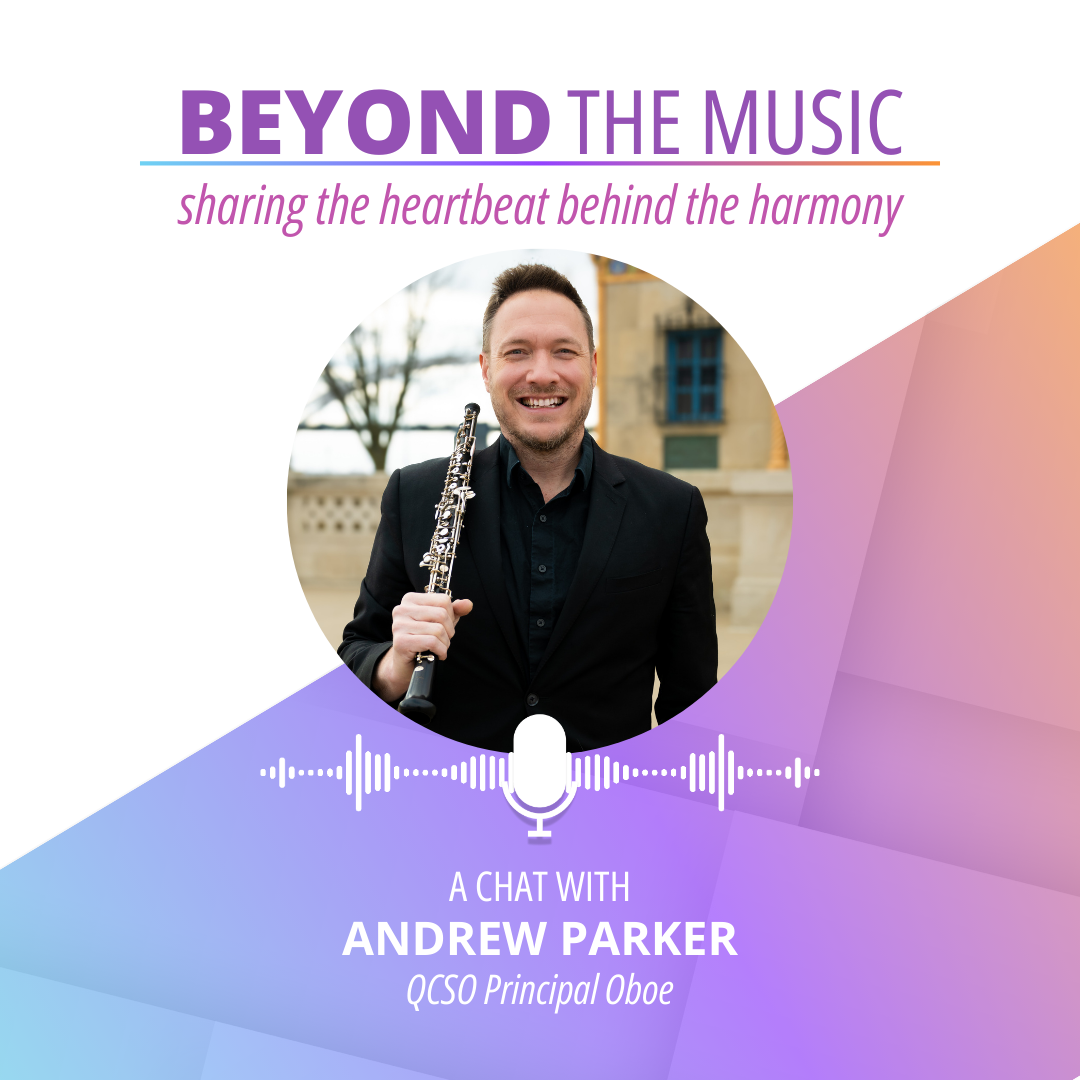
In this episode of Beyond the Music, Executive Director Brian Baxter sits down with Andrew Parker, Principal oboe of the Quad City Symphony Orchestra, ahead of his upcoming Up Close recital.
Andy shares what excites him about performing new and unfamiliar repertoire, the added energy that comes with premiering works for the first time, and how he channels that edge into deeper musical expression. He also offers an inside look at the preparation behind a solo recital—from daily fundamentals and endurance training to the intensive craft of reed making, an often unseen but essential part of an oboist’s life. Andy reflects on the unique rhythm of a professional musician’s career and the meaningful connections that come from sharing music in intimate settings with audiences.
TRANSCRIPT:
Brian Baxter
All right. Welcome to Beyond the Music. I’m very pleased to be here with Andy Parker, our principal oboist of the Quad City Symphony Orchestra. Thanks for joining.
Andrew Parker
Absolutely. Thanks for having me. I’m happy to be here.
Brian Baxter
Yeah, and we’re thrilled to have you performing on our Up Close series this weekend to kick off 2026. I was wondering if you could share a little bit about what excites you most about the upcoming performance and if there’s any particular moments you want the audience to really tune in for.
Andrew Parker
Yeah, absolutely. I think what excites me the most about it is that I’m playing two pieces that I’ve never performed before. Two pieces that are completely brand new to me, as of the past few months. And that, you know, hasn’t happened a lot in the past 10 years. A lot of the repertoire I’ve performed has been stuff that I was familiar with or have performed before, but this is really new material for me that kind of came into my purview because my husband found them. He’s an incredible researcher. He’s a professor at UT and he loves, He has sort of a passion for finding oboe repertoire for me to perform and record. So two of the three pieces I’m playing are things he found for me that I had never heard of before and that I had never played before. So I’m super excited to get to share these new works with the Quad City community, which is a community, you know, I hold very dear.
Brian Baxter
That’s great. Yeah, yeah. Well, and so uniquely, perhaps it will be not only a new experience of music to the audience who likely hasn’t heard these pieces, but it will be new to you. who has never performed them in front of an audience, right? So what does that feel like?
Andrew Parker
Exactly. Well, it adds this little extra sort of sparkle of, I don’t want to say fear or nervousness, but you know, performing new pieces that you’ve never done before for the first time is there’s a little bit of extra sort of spiciness in that process. So. Right. So and I’ve had to learn over the years of doing this for a living how to sort of channel that little bit of extra energy into going deeper into the music and in the performance. So I’m really looking forward to like facing that nervousness and sort of transforming it into something that makes hopefully the performance more exciting and engaging.
Brian Baxter
Yeah, that’s great. A little edge to the performance, you know, like something that’ll really draw the audience in. That’s great. So I wanted to ask what what’s your preparation like? I don’t think audiences necessarily know what goes into preparing to perform a full recital where you’re playing the oboe the whole time.
Andrew Parker
Absolutely. Well, there’s two. I would say there’s two levels to the preparation for something like this. There’s, you know, level one is your day-to-day work that you’re doing all the time, regardless of if you have any performances coming up. We would call it maybe, you know, working on our fundamentals or maintaining our playing. I’m constantly every day working on my scales, working on my arpeggios, refining, honing, trying to make my technique more effortless. So that’s going on all the time.
Brian Baxter
Right. You’re in the oboe, the oboe weight room, right?
Andrew Parker
Exactly. That’s been going on for years and years and years and will hopefully continue to go on for years. And then when you have a recital like this coming up, you sort of have to then sort of fold your work on the repertoire that you’re playing into that day-to-day process of working on your fundamentals and figure out how to sort of meld those two.So you’re sort of essentially, well, the phrase people say is killing two birds with one stones but I don’t like that phrase because I have two birds. But essentially that’s what you’re doing. You’re trying to both learn the music and figure out how to use that music to help you continue honing and refining the fundamentals of your playing. Because I don’t know if people know this, but the oboe is an instrument that is very demanding from an endurance point of view, and to play a full recital you have to really be in great shape. Your playing is to feel really fluid and easy and effortless. And then there’s also, I almost forgot because we usually don’t have to talk about this, but there’s the reed making that goes into it as well, something that is a big part of an oval player’s process. I usually spend about two hours a day on reed making.
Brian Baxter
Wow. Wow. Yeah, that is a when you talk to double reed players, it’s that’s a a whole scene that’s foreign even to other musicians of other instruments. So.
Andrew Parker
100% and we don’t like to talk about it too much because it’s probably very boring. But The thing is, people don’t understand that the reed making is, although very rewarding part of our craft, it’s also extremely difficult and very time-consuming. So if you want to be an oboist, you have to realize that that’s going to be a lot of the time you spend.
Brian Baxter
You’re you’re making reeds. Yep. Yeah, absolutely. Well, last question for you. Is there anything, is there one thing that you wish the general audience, general public knew about life as a professional musician?
Andrew Parker
Oh well, I would say that it is probably atypical for for many people. Now I am a college professor, so my job is probably a little bit more akin to a lot of people’s jobs where it’s a little bit more of like that 9 to 5 thing, right? But but I, you know, I have a lot of gigs that come in and out of my life that, you know, change sort of the rhythm of my day-to-day life quite frequently. Sometimes I’ll have, you know, a weekday totally free, but then I’ll be rehearsing performing all weekend. So the structure of a professional musician’s life is is a little bit, I think, more varied and you kind of have to get used to the fact that from week to week your schedule is potentially going to look quite a bit different. And one thing that I would say I really love about it is all the people I get to meet. I mean, just recently, yesterday and the day before, I got to play a concert in for this chamber music series in Austin that takes place at people’s houses and you play for people in these big beautiful houses and you get to talk to the audience after the concert and have hors d’oeuvres with them and get to know them and they ask you questions. So there’s this really nice intimate quality to that and I love getting a chance to meet and talk to people about our art form and about the music that I’m playing or that we’re playing. And you know, invariably the the audience goers tell me every time how meaningful it was for them to actually get to talk and learn about my process and the music and all of that.
Brian Baxter
Yeah, that’s that’s wonderful. It’s a unique schedule, varied schedule and and you do, you’re right, you get to meet a lot of different people. So that’s that’s fantastic. Well, thank you for joining us, Andy. I hope everyone can make your recital on the Up Close series Saturday, January 10th.
Brian Baxter
Uh, we’ll see you all there.
Andrew Parker
Thank you so much. We’ll see you on Saturday.
Beyond the Music: sharing the heartbeat behind the harmony
Beyond the Music: Sharing the Heartbeat behind the Harmony takes you behind the scenes of the Quad City Symphony Orchestra to meet the musicians, staff, and community members who bring the music to life.
Through candid conversations and personal stories, this series explores the passion, people, and purpose that drive every performance, giving you a deeper connection to the symphony and the harmony it creates both on and off the stage.