

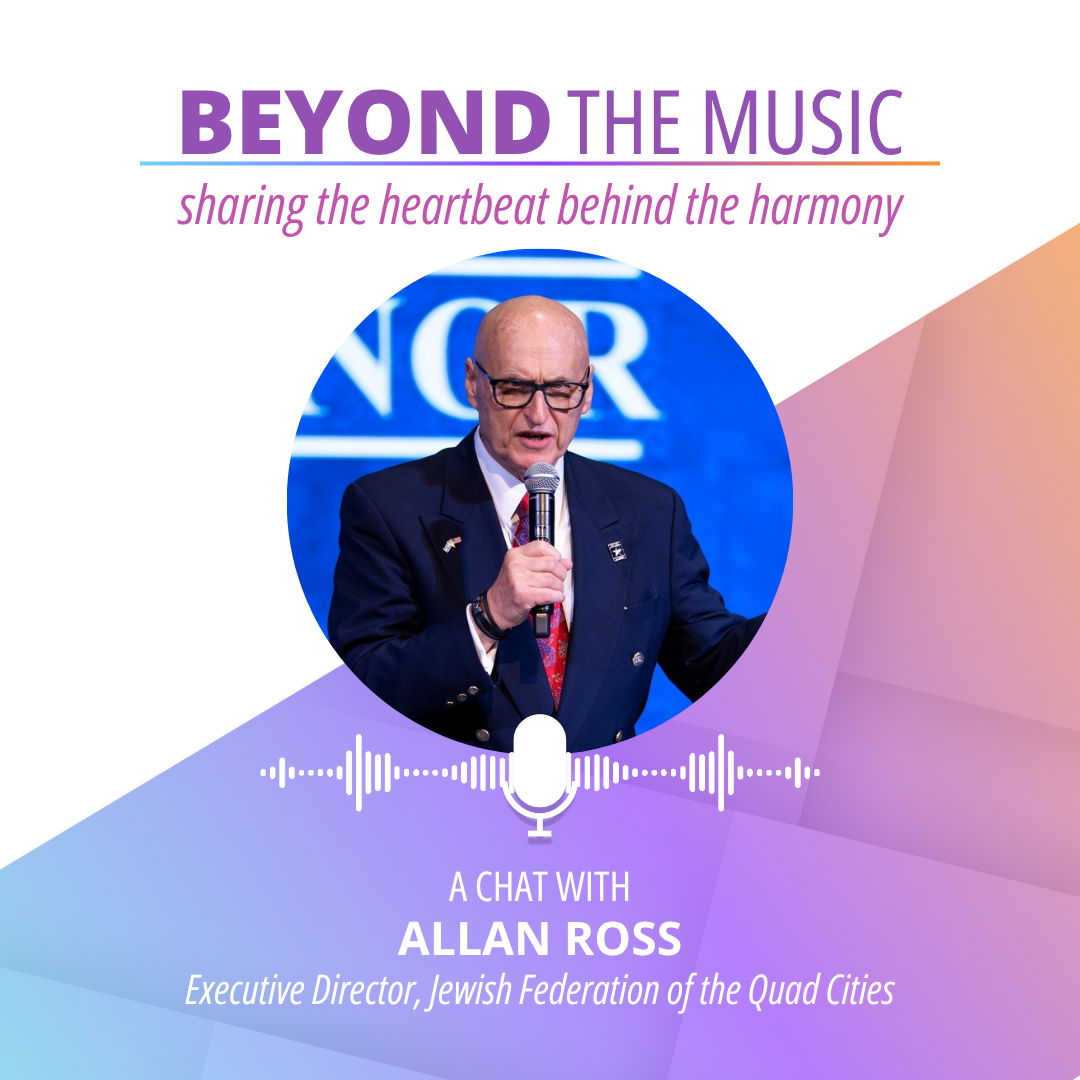
On this episode of Beyond the Music, QCSO Executive Director Brian Baxter speaks with Allan Ross, Executive Director of the Jewish Federation of the Quad Cities, about the powerful international project Violins of Hope, coming to Iowa this spring.
Featuring 69 restored string instruments played by Jewish musicians before and during the Holocaust, Violins of Hope brings history to life through sound. Ross shares how these violins — many of them still playable — survived when so many of their owners did not, and how they now serve as moving symbols of resilience, remembrance, and the enduring human spirit.
With Iowa’s new statewide Holocaust education mandate, Ross discusses the importance of giving students and educators a tangible, emotional connection to this history. He also highlights the Quad Cities–based events, including two QCSO performances and a series of community exhibitions at cultural institutions across the region.
Offering insight into the project’s mission and its relevance in today’s divided world, this episode invites listeners to explore how music can teach, heal, and inspire hope for a better future.
TRANSCRIPT:
Brian Baxter:
On this episode of Beyond the Music, I’m pleased to be joined by Allan Ross, Executive Director of the Jewish Federation of the Quad Cities. Allan, thanks for joining us.
Allan Ross:
I’m glad to be here.
Brian:
We have a major project coming up called Violins of Hope. What is Violins of Hope?
Allan:
Violins of Hope is an international project centered around 69 instruments — 67 violins, one viola, and one cello. These instruments belonged to Jewish musicians before and during the Holocaust. They were played in concerts, in ghettos, in concentration camps, and in work camps. Somehow, the instruments survived this horrific period, even though many of their owners did not.
They’ve been lovingly restored by the Weinstein family in Israel, and the project has traveled the world — Rome, Berlin, Chicago, New York, Los Angeles — and now they’re coming to the state of Iowa. We’re incredibly excited.
Brian:
Absolutely. It’s a statewide initiative, and they’ll be in various locations across Iowa. For today, we’re focusing on what the Quad Cities community can expect. What excites you most about bringing Violins of Hope here?
Allan:
One of the most exciting aspects is that the state of Iowa has now mandated Holocaust education in public schools. Violins of Hope gives students and educators a chance to encounter history firsthand — something they can see, touch, and hear.
These instruments were played during the Holocaust. Many are still playable. They offer a powerful, tangible connection to what happened, and they help us teach not only the history of the Holocaust but also the lessons we must carry forward.
Brian:
Right. And those lessons come through in the instruments and the music they’ll produce. The Quad City Symphony Orchestra is presenting two concerts — a Masterworks performance and an Up Close chamber concert — centered around the theme of Violins of Hope. Among the Symphony’s programming, what are you most looking forward to?
Allan:
We’re hoping to have as many students and classes attend as possible. Beyond the Symphony concerts, we’re bringing in additional musical programs throughout the Quad Cities. But students are really the people we’re trying to reach.
Brian:
Absolutely. It’s critically important. Violins of Hope carries a message of hope — learning from the horrors of the past to build a better future. What’s the main message you want the Quad Cities community to take away from this project?
Allan:
These instruments are powerful symbols of resilience, remembrance, and humanity. We want to teach not only the history of the Holocaust but the lessons learned from it.
In today’s divisive society, with so much hate, we want to offer something that brings people together — something that inspires hope and encourages us to work toward a better future for our community and for humanity.
Brian:
I couldn’t agree more. Music has a unique ability to unite people and strengthen communities. We’re thrilled to be part of this project.
Our Masterworks concert in April and our Up Close chamber concert — also in April — will feature these instruments. And on February 17, we’ll have a major announcement about the full project, including where the violins will be displayed throughout the community: the Figge Art Museum, the German American Heritage Center, the Putnam Museum, and many other partner locations.
Thank you, Allan, for joining us on Beyond the Music.
Allan:
And thank you for partnering with us on this important project. It’s going to be exciting and very meaningful for our community.
Brian:
Absolutely. We’ll see you all in the concert hall and around the community.
Beyond the Music: sharing the heartbeat behind the harmony
Beyond the Music: Sharing the Heartbeat behind the Harmony takes you behind the scenes of the Quad City Symphony Orchestra to meet the musicians, staff, and community members who bring the music to life.
Through candid conversations and personal stories, this series explores the passion, people, and purpose that drive every performance, giving you a deeper connection to the symphony and the harmony it creates both on and off the stage.