

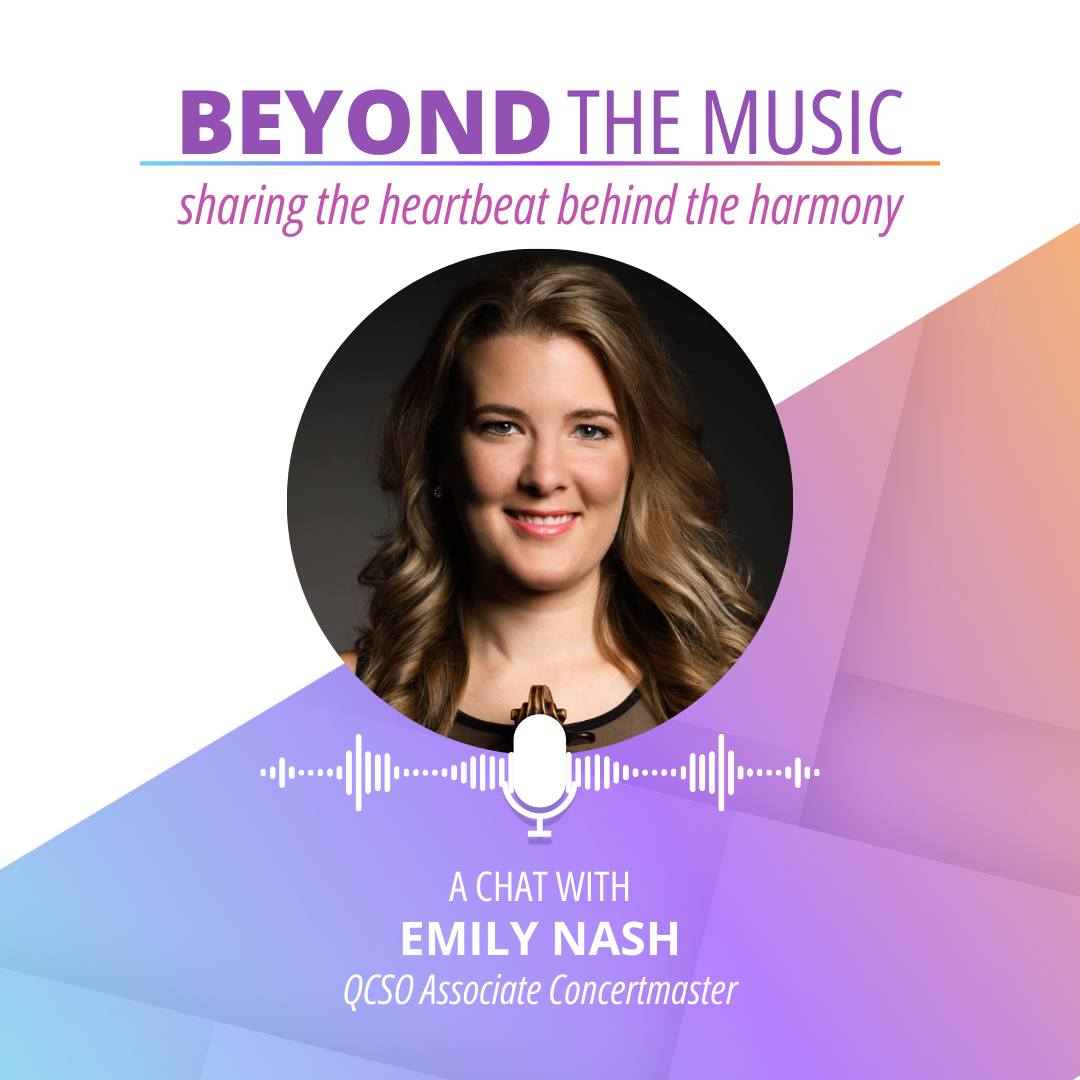
On this episode of Beyond the Music, QCSO Executive Director Brian Baxter sits down with Associate Concertmaster Emily Nash to explore the inspiration behind Up Close III: Blueprint, a richly textured program centered around Caroline Shaw’s inventive string quartet.
Shaw’s Blueprint—a vibrant, pitch‑bending work influenced by Beethoven and the deep indigo tones of Japanese woodblock printing—serves as the musical and conceptual anchor for a program that weaves together unexpected connections of color, culture, and sound. Nash shares how the concert journeys from the classical clarity of Beethoven’s Op. 18 No. 6 to the shimmering textures of Krzysztof Lenczowski’s Adonis Blue, inspired by the delicate movement of a butterfly. The program also includes Philip Glass’s hypnotic String Quartet No. 3 (“Mishima”) and Puccini’s rarely heard chamber gems—Crisantemi and selections from his Three Minuetti—revealing new dimensions of composers audiences may think they already know.
Throughout the conversation, Nash offers a window into her creative preparation, from immersive “method acting” approaches to the deep score study that fuels her performances. She reflects on the intimacy and collaborative bravery of chamber music, where four musicians must simultaneously lead, follow, and shape the musical arc together.
The episode highlights the imagination, curiosity, and artistic resilience behind Up Close III, a program that invites audiences to hear color, culture, and connection through the vivid possibilities of the string quartet.
TRANSCRIPT:
Brian Baxter:
I’m so glad to be joined today by Emily Nash, Associate Concertmaster of the Quad City Symphony Orchestra. Emily, thanks for being here on Beyond the Music.
Emily Nash:
Thank you for having me.
Brian:
We’re here to talk about your upcoming Up Close performance, which you’re presenting with a QCSO string quartet. What excites you most about this program?
Emily:
This concert has been about a year and a half in the making. I had performed a piece by Caroline Shaw a few years ago and later took a deeper dive into her work. When I discovered her string quartet Blueprint, I knew immediately: I need to build an entire concert around this piece. From there, I began threading together works that relate to it in different ways.
Shaw is close to my age, and I love the way she bends pitch and plays with sonic color—sometimes it even feels a little dizzying. Her music has so much energy, and Blueprint became the anchor for the whole program.
Brian:
I’m excited to bring her music to our audience, especially since we haven’t featured her on Up Close before. This performance showcases a string quartet, which is a very different setting from the full symphony orchestra. What is it like shifting into that more intimate ensemble?
Emily:
In the orchestra, the conductor is our guide, and we follow the principals of each section. In a quartet, it’s just the four of us. We all have to be soloists, but also deeply communicative—flexible, generous, responsive. Everyone gives and takes. To make great chamber music, you have to bring out each other’s best. It’s incredibly intimate.
Brian:
Absolutely. Our Up Close audiences love being physically close to the performers—it feels like being inside the music. I’ve always thought chamber music is almost like playing in a rock band: interactive, collaborative, driven by the players.
Emily:
Definitely. In a quartet, we control the tempo, the flow—everything.
Brian:
The program features a range of composers—Beethoven, Shaw, Puccini, Glass, and Krzysztof Lenczowski. Are there particular musical threads you’re excited to highlight?
Emily:
What I love about this concert is that every piece sounds completely different, yet there’s a subtle thread running through all of them. For example, Blueprint is loosely inspired by the harmonic structure of Beethoven’s String Quartet Op. 18 No. 6. So we’re beginning the program with the Beethoven—something familiar—so that listeners can hear how Shaw reimagines the language of classic quartet writing.
Shaw wrote Blueprint for the Aizuri Quartet, whose name references Japanese woodblock printing. During that period, Japan was importing the deep blue pigment Prussian blue—what we know as indigo. Shaw ties these ideas of pigment and architectural “blueprints” into the piece, and that sparked a theme of “blue” throughout the program.
Following that thread, I discovered Krzysztof Lenczowski’s Adonis Blue, inspired by the movement of a blue butterfly. He uses techniques like pizzicato and col legno to evoke fluttering textures. It’s incredibly vivid.
The Japanese connection also led me to Puccini. Most people know Madame Butterfly, but he actually wrote three minuets for string quartet, plus a short elegy called Crisantemi (“Chrysanthemums”), which he composed in a single evening as a memorial to a friend. The chrysanthemum in Italian culture represents mourning, and the piece is beautifully poignant.
And finally, we’re playing Philip Glass’s String Quartet No. 3 (“Mishima”), drawn from his score to Mishima: A Life in Four Chapters. The film is dark—not for the kids—but the quartet is hypnotic, dramatic, and deeply atmospheric. All these pieces connect in unexpected ways through color, texture, and ideas of influence.
Brian:
That’s such a rich set of connections. One of the things audiences love about Up Close is hearing musicians talk about the works and what inspired a program like this. Before we go, is there something you wish more people knew about the life of a professional musician?
Emily:
Honestly, it still feels mysterious to me sometimes! We drive a lot, practice constantly, juggle multiple musical worlds. When I prepare for a program, I approach it like a method actor—I watch films, read books, explore anything related to the music. For this concert, for example, I watched Mishima and read around its context. Immersing myself makes performing even more meaningful.
People should know how resilient musicians are. We’re probably tired—we don’t sleep enough—but we’re endlessly dedicated. I practice all the time, and I often study directly from the full scores. Even as I’ve gotten more experienced, I’ve learned that practicing never becomes optional; it only becomes more necessary.
Brian:
Absolutely. Preparation is huge. And we’re so excited for this concert on March 15 at the Figge Art Museum, with this fantastic quartet of musicians—Naha Greenholtz, Bruno Vás de Silva, Hannah Holman, and of course, you.
Emily:
They’re all musicians I deeply respect, and I’m thrilled to play with them.
Brian:
Thanks, Emily. We can’t wait to hear the performance.
Emily:
Thank you, Brian.
Beyond the Music: sharing the heartbeat behind the harmony
Beyond the Music: Sharing the Heartbeat behind the Harmony takes you behind the scenes of the Quad City Symphony Orchestra to meet the musicians, staff, and community members who bring the music to life.
Through candid conversations and personal stories, this series explores the passion, people, and purpose that drive every performance, giving you a deeper connection to the symphony and the harmony it creates both on and off the stage.