

PROGRAM NOTES
ARTIST BIOGRAPHIES
Hannah Holman, cello
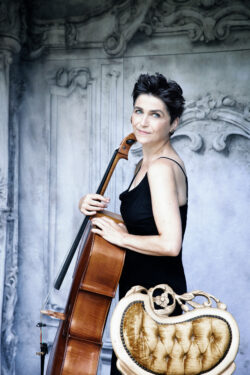
Hannah Holman, cellist, joined the New York City Ballet Orchestra at the beginning of the 2012-2013 season. Her career has encompassed orchestral and chamber music, solo performances, and teaching. In a review of the second CD she recorded with pianist Réne Lecuona, Fanfare magazine declares “her tone and technique are the stuff that cello legends are made of “… Holman’s cello sings with a lustrous tone that’s hard to resist.”
In addition to her work with the New York City Ballet Orchestra, Ms. Holman is the principal cellist of the Quad City Symphony, a position she has held since 2008. She began her professional career in England playing with the English String Orchestra under Yehudi Menuhin and the City of Birmingham Symphony Orchestra under Simon Rattle. Her previous orchestral work also includes serving as assistant principal cello with the Michigan Chamber Orchestra, the Richmond Symphony; and the American Sinfonietta.
Hannah is fortunate to have a diverse career allowing much time for solo work. 2025 has been a very busy and exciting year so far, and more to come…Hannah performed the Rococo Variations by Tchaikovsky with the Sheboygan Symphony, WI,in March, she performed the Jermone Robbins Suite of Dances at both Lincoln Center and the Joyce Theater, she performed a Beethoven Sonata duo recital with Davide Cabassi in Milan Italy, and she just got back from performing 2 recitals in Germany. Upcoming highlights include a performance of the Elgar Cello Concerto with the Yonkers Philharmonic in November, a UK tour of the music of Eric Starr from the recent CD, Between the Sandhills and the Sea, and premiering a brand new cello concerto she commissioned by Rebecca Burkhardt with the Quad City Symphony Orchestra in March 2026. Other more recent career highlights include post production of CD #3 with Réne Lecuona featuring cello sonatas by late romantic female composers. Other recent concertos with the QCSO have included Schelomo by Bloch, the Korngold Cello Concerto and Jennifer Higdon’s Soliloquy, She is in the middle of a video project highlighting the lives of women cellists from the past, and performed six pieces with the Iowa City Community Chamber Orchestra, each piece focusing on a different cellist. She performed the 4th Cello Suite of J.S. Bach in Carnegie Hall on March 3, 2020 as part of the Bach Cello Suite Festival, celebrating 300 years of the cello suites.
An active chamber musician, Ms Holman helped found Trio 826, with her dear friends Susanna Klein, violin, and Julia Bullard, viola. She was a founding member of the Beaumont Piano Trio, which performed around the United States and England, and was also a founding member of Quadrivinium, a music ensemble in residence at the Virginia Museum of Fine Arts. From 2002-2011, she was a member of the Maia Quartet, the University of Iowa’s quartet in residence, which toured China, Japan, and throughout the United States, including teaching residencies at Interlochen Center for the Arts, the Great Wall International Music Academy in China, and the Austin Chamber Music Center. She regularly performs in chamber ensembles with musicians from throughout the United States and Europe.
A dedicated private teacher who finds great fulfillment in helping students of all ages grow musically, Ms. Holman was on the University of Iowa music faculty from 2002-2012, and most recently was on the faculties of the University of Northern Iowa and Biola Conservatory. She has also served on the faculties of the Worcester College (UK), Michigan State University Community School, and Virginia Union University. She has participated in numerous festivals, and has been on the faculty of the Eastern Music Festival since 2001 and currently serves on the faculty of the International Cello Institute, the Wintergreen Festival, and Taconic Music. Hannah is the founder and Artistic Director of a new music school based in the Quad Cities, The Deanery School of Music.
Ms. Holman studied at the Eastman School of Music and Michigan State University, where she completed her Bachelor of Music degree. She obtained her Master of Music Degree with Fritz Magg at the New England Conservatory. Hannah was fortunate enough to have several lessons with William Pleeth in London as postgraduate study. Her musical education began at age 5 with her grandmother. She is eternally grateful for the fine teaching of a transformative teacher, Louis Potter, during her junior high and high school years.
Hannah is delighted to have found a gorgeous J. B. Vuillaume cello from 1856 in 2024, and is loving getting to know it.
Ms. Holman – whose hobbies include foodie and thrifting activities, as well as traveling to new places- lives in NYC. Please visit her at her website: hannahholmancello.com
Rebecca Burkhardt, composer
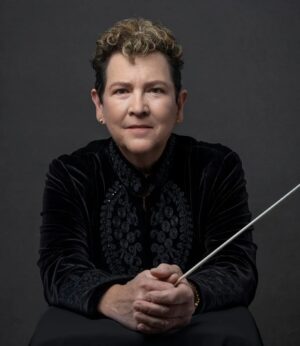
Conductor, composer, and Professor Emeritus Rebecca Burkhardt is sought after as a guest conductor for professional and educational orchestras throughout the United States and abroad. She served as the Director of Orchestral Activities at the University of Northern Iowa from 1988-2020. Besides her duties as Music Director of the Northern Iowa Symphony Orchestra, she performed as the conductor for the UNI Opera Theatre, and served as a professor on the music theory and conducting faculties at UNI.
Dr. Burkhardt’s compositions are wide-ranging including works in the choral, chamber music, orchestral, and musical theatre genres. Her commissions include incidental music for The Laramie Project and Dead Man’s Cell Phone, Where Sky, Where Pilgrim for the choral ensemble Bel Canto Cedar Valley, BluesWomenTryptich for the string ensemble Trio 826, and Fanfare for a First Lady composed in honor of Michelle Obama’s UNI commencement address. A Scotch Verdict, her musical written in collaboration with Cynthia Goatley, was presented in a concert performance as a part of Stages, a new musical festival sponsored by Theatre Building Chicago. Her newest musical, Just Ann, another collaboration with Goatley, is based on the life of Texas Governor Ann Richards and received a workshop performance in 2017.
From Dialogue of the Carmelites and Madame Butterfly to Fiddler on the Roof and HAIR, her opera and theatre performances encompass the gamut of music-drama and musical comedy. She has appeared as guest conductor with professional, university and high school honor orchestras throughout the nation and internationally in Russia, France, Brazil, Costa Rica and China. Her honors include the Award for Faculty Excellence given by the Iowa Board of Regents and a Lifetime Achievement Award from the College Orchestra Directors Association, for which she served twice as National President.
She has performed with solo artists Wen Wei, Simon Estes, Sheri Greenawald, Fei Xie, Lan Weiwei, Laurie Smukler, Elizabeth Adkins, Helen Callus, and the Interro Quartet among many others. Burkhardt has worked closely with composers-in-residence Michael Daugherty, Dan Welcher, Libby Larsen, Ao Xiang, Sam Adler and Jake Heggie. Recently she conducted the premiere of The Suffragist, a new musical by Nancy Cobb and Cavan Hallman, featuring Tony nominee, Nancy Opel.
A native of Texas, Dr. Burkhardt earned a Bachelor of Music degree from Southwestern University (TX), a Master of Music Education degree from the University of North Texas, and her Ph. D. at the University of Texas, Austin. She currently lives with her spouse Cynthia Goatley in Santa Fe, NM.
PROGRAM NOTES
written by Jacob Bancks,
Professor of Music, Augustana College
LEONARD BERNSTEIN • Three Dance Episodes from On the Town
LEONARD BERNSTEIN
(1918-1990)
INSTRUMENTATION:
Flute (doubling piccolo), oboe (doubling English horn), three clarinets (first doubling E-flat clarinet, third doubling bass clarinet), alto saxophone, two horns, three trumpets, three trombones, timpani, two percussion, piano, and strings.
QCSO PERFORMANCE HISTORY:
These are the first QCSO Masterworks performances of Three Dance Episodes. The third movement (“Times Square: 1944”) was performed on the 1995 Riverfront Pops concert (Kim Allen Kluge conducting) and on the 2011 Patriotic Pops concert (Mark Russell Smith conducting).
The multifaceted persona of Leonard Bernstein lives large in American music history. We see him now as a world-renowned conductor, a composer of profound and innovative concert works, a television celebrity, a socialite, a multi-millionaire, and an activist. But before November 1943, he was as yet none of these things. Bernstein had graduated from Harvard College in 1939 and went on to study at the Curtis Institute in Philadelphia with Fritz Reiner, completing his studies there in 1941. The years immediately following his time at Curtis were uncertain times; Bernstein continued serving as assistant conductor to Serge Koussevitzky at Tanglewood during the summers, but the rest of the year was spent struggling in New York, where his odd jobs included accompanying dancers, teaching, and transcribing popular piano music for $25 per week.
Everything changed for Bernstein during the 1943-44 season. His last-minute debut with the New York Philharmonic at Carnegie Hall on November 14, 1943 was a massive sensation; Bernstein received widespread acclaim, even appearing on the front page of The New York Times the following day. This triumph was followed by two highly successful premieres of his own music: Symphony No. 1, “Jeremiah” with the Pittsburgh Symphony Orchestra in January of 1944, and the ballet Fancy Free, with choreography by Jerome Robbins, at the Metropolitan Opera House in April. He capped his successes of the 1943-44 season with a celebrated conducting debut at the Hollywood Bowl in August.
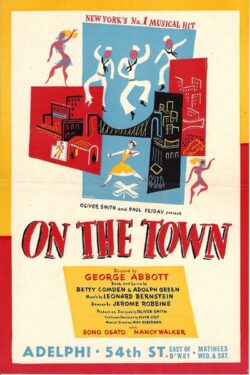
It was following this astonishingly successful season that Bernstein’s musical On the Town opened on Broadway. The ballet scenario for Fancy Free concerned three Navy sailors on leave; the production’s illustrious and enterprising set designer Oliver Smith liked the story so much he suggested adapting it into a full-length musical. Working with witty lyrics fashioned by his friends Betty Comden and Adolph Green, Bernstein decided to avoid repurposing any of the music from Fancy Free, instead fashioning an exuberant, jazz-infused original score. Considered an investment risk due to the youth and inexperience of its composer and lyricists, On the Town turned out to be a smash hit, running for 462 performances. “The freshest and most engaging musical show to come this way,” wrote The New York Times, “since the golden day of Oklahoma!”
Not everyone appreciated the sophisticated nature of Bernstein’s score. When MGM Studios took up the film version, storied producer Arthur Freed (with musicals like The Wizard of Oz and Singin’ in the Rain to his name) objected. He considered Bernstein’s music too refined and operatic for most film audiences, and retained only four of the Bernstein/Comden & Green songs for his film. Bernstein was furious at having his work decimated, and loudly boycotted the film’s premiere.
Concert audiences, however, would come to appreciate Bernstein’s original musical far more than the short-sighted Hollywood types ever would. In 1945, Bernstein published Three Dance Episodes from On the Town, re-orchestrated for full symphony orchestra, which has become one of the composer’s most-performed concert works.
LISTENING GUIDE
The Great Lover (Allegro pesante)
- Rhythm: Bernstein is almost maniacally focused on emphasizing his offbeats, placing strong notes in rhythmic positions away from the beat.
- Instrumentation: The original Broadway score for On the Town would have been written for a standard pit orchestra, where woodwind players played multiple instruments. Though these concert excerpts are orchestrated for a much larger ensemble, the combinations of various woodwinds harkens back to the original, more limited ensemble.
Lonely Town: Pas de Deux (Andante sostenuto)
- Harmony: Always the master of American popular musical styles, Bernstein infuses this movement with chords and melodies drawn from the blues.
Times Square: 1944 (Allegro con spirito)
- Rhythm: Bernstein interrupts the more driving passages of this movement with relaxed interludes. He does so by using a rhythmic pattern called a “jazz two-feel”, where only beats 1 and 3 are emphasized.
- Style: Several years after writing On the Town, Bernstein would dedicate his work Prelude, Fugue, and Riffs to clarinetist Benny Goodman; passages of this movement show he had already internalized Goodman’s signature style.
REBECCA BURKHARDT • Ballet for Cello & Orchestra
REBECCA BURKHARDT
(b. 1957)
INSTRUMENTATION:
solo cello, three flutes (third doubling piccolo), two oboes (second doubling English horn), two clarinets (second doubling bass clarinet), two bassoons (second doubling contrabassoon), two horns, two trumpets, two trombones, tuba, timpani, three percussion, harp, piano, and strings.
WORLD PREMIERE PERFORMANCES
Composer Rebecca Burkhardt writes:
When cellist Hannah Holman asked me to write a concerto for her, I asked what was important about where she lived and worked. I wanted this piece to reflect her life and the lives of other women in those places. The locales she thought were most important to her life were: a suburb near Detroit where she grew up, Iowa where she lived, raised her son and still works, and New York City where she currently resides and plays in the NYC Ballet. Ballet for Cello and Orchestra is a tribute to her and to those like her who walk, dance, survive, fail, create, toil and aspire to achieve wonderful things. Sometimes we take on this dance alone, and sometimes with a partner or a community. The three movements reflect the sounds, landscapes and essences of Iowa, Detroit, and New York City.
Movement I, Walking, conjures the cry of indigenous ancestors who walked the plains of this country, the migration of settlers, the harshness of conflict between peoples and the starkness of a life enveloped by wilderness and winter.
Movement II, Working, begins with a day breaking into the howl of a factory whistle. Motives of the Motown sound mix with the low grind of factory mechanisms and end in a continuously rising treble shout between the cello and the orchestra.
Movement III, Wondering, continues from movement II with an exploration of dance in the performance wonderland of Manhattan. The sounds of early Harlem and Puerto Rican rhythms combine with classical balletic melodies to invoke the euphoria of creative success, the exasperation of inequity and failure, and a hope and wonder for what might come next.
LUDWIG VAN BEETHOVEN • Symphony No. 2 in D major, Op. 36
LUDWIG VAN BEETHOVEN
(1770-1827)
INSTRUMENTATION:
Two flutes, two oboes, two clarinets, two bassoons, two horns, two trumpets, timpani, and strings.
QCSO PERFORMANCE HISTORY:
Ludwig Becker conducted the first performances of Beethoven’s second symphony in January 1922, and performances conducted by Frank Kendrie followed in November 1934. The work was then dormant for over five decades, until James Dixon led performances in November 1986 as part of a two-year cycle of all nine Beethoven symphonies. The most recent performances were conducted by guest conductor Gustav Meier in December 1996.
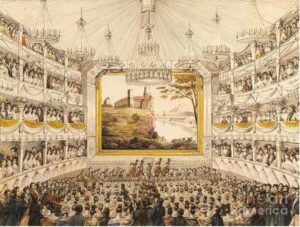
In 1791, near the end of his short life, Mozart premiered his masterpiece of German opera, Die Zauberflöte (The Magic Flute) at the Theater auf der Wieden (“Theatre on the Vienna River”) in the suburbs of the imperial capital. Notwithstanding the composer’s untimely death, The Magic Flute was a tremendous public success, earning a fortune for Mozart’s collaborator Emanuel Schikaneder, who had written the opera’s libretto and created the unforgettable comic role of Papageno. Schikaneder used the proceeds from his success to build an opulent new theatre to replace the somewhat modest venue where The Magic Flute had premiered. The new, confusingly-named Theater an der Wein (i.e., “at” the river, not “on” the river this time) opened its doors in 1801. Public and critical responses were effusive. “Schikaneder is up to his old tricks in the suburbs on the Wien River,” wrote author Johann Gottfried Seume, “where he has built himself a very stately house, the furnishings of which many a theater director could and should visit with benefit.” Critic Adolf Bäurle suggested that “visitors might have paid simply to look at the theatre’s splendors”, and the influential publication Allgemeine musikalische Zeitung deemed it “the most comfortable and satisfactory” performing venue “in all German-speaking lands.”
Immediately following the death of Mozart, Ludwig van Beethoven had moved to Vienna from the western German city of Bonn at the age of 21. The young Beethoven attended performances of The Magic Flute at the older Theater auf der Wieden (it was his favorite Mozart opera), and he would certainly have been aware of the buzz around Schikaneder’s new venue. Just as the Theater an der Wien was opening, Beethoven began work on his Symphony No. 2, and would eventually arrange for its premiere at the opulent new hall.
The second symphony was composed primarily at the retreat town of Heiligenstadt (literally “Holy City”; now part of the city of Vienna) between April and October of 1802. Anyone familiar with Beethoven’s biography will immediately recognize the name of Heilegenstadt; it was there that he wrote his Testament: an excruciating letter to his brothers written amid the swelling grief over his deafness.
“For six years I have been a hopeless case,” he wrote his brothers. “I was compelled early to isolate myself, to live in loneliness, when I at times tried to forget all this, O how harshly was I repulsed by the doubly sad experience of my bad hearing, and yet it was impossible for me to say to men, ‘Speak louder, shout, for I am deaf.’” Beethoven conveyed his profound embarrassment at losing his hearing (“the one sense which should have been more perfect in me than in others”), and confessed to contemplating ending his own life. “Divine One,” he wrote in a prayerful interlude, “thou lookest into my inmost soul, thou knowest it, thou knowest that love of man and desire to do good live therein.” His anguished postscript includes the autumnal lament “even the high courage — which often inspired me in the beautiful days of summer — has disappeared.” Beethoven would return to Vienna that month, his newly-completed second symphony ready for performance.
The audience that gathered in Schikaneder’s beautiful new Theater an der Wien the following April for the premiere might not have guessed the agony that Beethoven had confessed the previous summer. Indeed, they would likely have felt that they were beholding a confident, rising musical superstar. This marathon concert included the world premieres of Symphony No. 2, Piano Concerto No. 3, the oratorio Christ on the Mount of Olives, and a performance of Beethoven’s previously-premiered Symphony No. 1. And the second symphony itself, with its energy, vigor, and humor, betrayed none of the personal torment Beethoven had written about to his brothers while he completed the work.
Beethoven would return many times to perform at the Theater an der Wien, and he premiered many of his most well-known works there, including Symphony No. 3, “Eroica” (1805), his only opera Fidelio (1805), his Violin Concerto (1806), and, in another colossal production reminiscent of the concert of 1803, his Symphonies Nos. 5 and 6, the Choral Fantasy, and his Piano Concerto No. 4, all in a single evening. Unlike many theatres from this era, Schikaneder’s venue is still an active performance hall, having seen various additions and renovations, most recently in 2024.
LISTENING GUIDE
First Movement: Adagio molto – Allegro con brio
- Texture: Beethoven’s slow introduction is a study in orchestral contrasts, with highly varied textures and moods; it seems almost as if Beethoven is trying out various ideas before deciding on which to move forward with. Having decided, his transition into the main Allegro section is seamless.
Second Movement: Larghetto
- Melody: As is typical for symphonies in Beethoven’s time and place, the slow movement includes a simple melody that Beethoven transforms in various ways. It is fairly easy to identify the main tune when it returns; its first four notes are the same as the opening of the song “Home on the Range” (“Give me a home…”).
Third Movement: Scherzo (Allegro – Trio)
- Tempo: This particular movement marks an important moment in symphonic history. The dance movement of most symphonies before Beethoven were stately, elegant minuets. But Beethoven felt the urge for something more exciting, so he started writing faster-paced, less genteel scherzos instead. He would return to the minuet years later in his eighth symphony.
Fourth Movement: Allegro molto
- Dynamics: For further thrills, Beethoven uses an extraordinarily high level of dynamic contrast in this closing movement.