

PROGRAM NOTES
ARTIST BIOGRAPHIES
Angel Lam, Composer

Grammy-nominated composer Angel Lam uses the beauty of melodies, instrumentation, and the written language to express detailed emotions and her passion for life. She tells vivid and intimate musical stories about life and death, human relationships, memories and inspirations that reaches people in a compelling and direct way. Her compositions are praised as “Timeless” by Carnegie Hall, “Precious, soaring lyrical lines” by Metropolitan Opera, Opera News, “a born storyteller” by Financial Times, and “both poignant and important” by Yo-Yo Ma.
She has a background in western classical and Chinese folk music, having learned to play the zheng and qin – ancient Chinese zithers, as a child. Lam’s work combines evocative, memorable melodies, an exploration of deeply felt human experiences, with her soul-searching sensitivity to spirituality.
She is one of America’s foremost female composers selected by the League of American Orchestras and the Toulmin Foundation. Upcoming, she will write three new commissioned works to be performed by nine professional North American orchestras. Her works had been performed by Atlanta Symphony, Minnesota Orchestra, Colorado Symphony, Kansas City Symphony, Utah Symphony, Jacksonville Symphony, Quad City Symphony, South Bend Symphony, New York Greenwich Village Orchestra, Yale Philharmonia, New York University Symphony Orchestra, Chicago Northwest Symphony, Hong Kong Sinfonietta, University of California Irvine Symphony, Aspen Music Festival Orchestra, among others. Most recently, she is also the recipient of Opera America’s Discovery Grant Award to develop her new musical-opera.
Previously, she was honored to receive three New York Carnegie Hall commissions before the age of 29, including a cello concerto dedicated to Yo-Yo Ma and the Atlanta Symphony Orchestra, conducted by Robert Spano. She also wrote a piece for Yo-Yo Ma and the Silk Road Ensemble’s worldwide tour, performing at prestigious venues like Lucerne Festival in Switzerland and the Royal Albert Hall in London. Recently she is a composer-in-residence at Yale University Norfolk Chamber Music Festival, where she is commissioned to write a new work for superstar pipa virtuoso Wu Man and artistic director Melvin Chen at their festival opening concert. She also curated, produced and composed a 2-hour concert program at Merkin Hall in New York titled “Hong Kong Journeys”, co-presented by the 25th Anniversary of the city of Hong Kong, and Hong Kong Economics and Trade Office of New York, with harmonica world champion Gordon Lee as guest artist. Her music is released by Sony Classical, Naxos Records, Albany Records and In a Circle Records.
Her works have been performed and recorded in 70 different cities worldwide by multiple touring ensembles, including Music at Copland House Ensemble (U.S. tour), Silk Road Ensemble (world-wide tour), Guitar Foundation of America (GFA International Concert Artists competition set repertoire, publication and worldwide recordings), Hub New Music Ensemble (U.S. tour and album release), Asia-America New Music Institute (Asia tour), Sulzbach-Rosenberg International Music Festival at the Konzertsaal des Rathauses, Bavaria, Germany, New Music for Strings Iceland Festival, in Reykjavik, Iceland, Radio Television Hong Kong (featured short film), Hong Kong Arts Festival, among others.
She was voted “Artist of the Month” by Musical America, “Yalie of the Week” by Yale University Yale Alumni Magazine, and a featured artist on Best Buy Inc.’s “Creative Minds” with the Minnesota Orchestra performing her orchestral work “In Search of Seasons,” conducted by Osmo Vanska.
More info at: angellam.com
The Nai-Ni Chen Dance Company
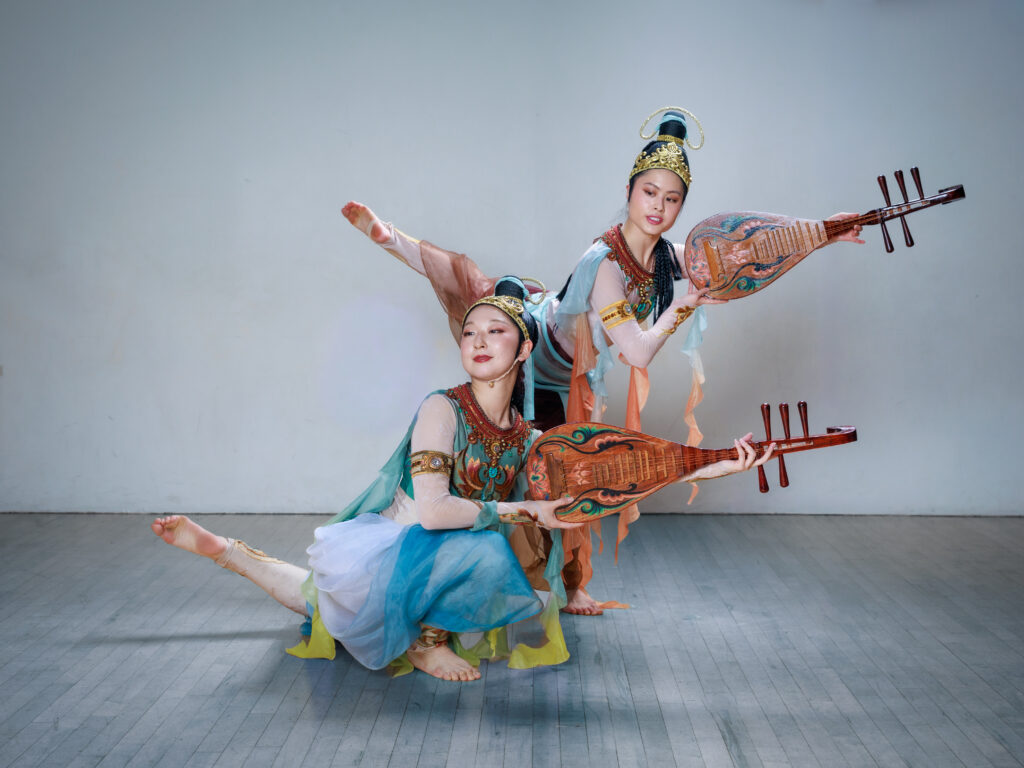
The Nai-Ni Chen Dance Company is a leading force in creating innovative cultural experiences that capture the hope, resilience, and energy of the immigrant journey. Bridging the grace of Asian elegance with the dynamism of American modern dance, the Company performs at the intersection of innovation and tradition, empowering communities through performances and interactive engagements. Through its productions, the Company fosters cross-cultural understanding while addressing important themes of identity, authenticity, and equality.
The Company’s success is evident in its extensive performance schedule, reaching more than 20,000 audience members each year through exuberant productions presented at prestigious venues such as The Joyce Theater and Lincoln Center in New York, Jacob’s Pillow, the Cerritos Center for the Performing Arts in California, the Ordway Center in Minneapolis, and the New Jersey Performing Arts Center, as well as on fifteen international tours spanning ten countries. Special productions for families have been presented by the New Victory Theater on Broadway, Lincoln Center Institute, and KREA in Michigan, among others.
Advancing dance education, the Nai-Ni Chen Dance Company works with K–12 schools year-round on imaginative, thematic projects that foster creativity and support learning across subjects. Currently, the Company is in residence at New Jersey City University’s A. Harry Moore Laboratory School, serving children with multiple disabilities.
The Company also regularly commissions new, cross-cultural works that reflect contemporary issues with global influences. These collaborations have included partnerships with renowned musicians such as the Ahn Trio, Glen Velez, Joan La Barbara, Angel Lam, Jason Huang, Liang-Xing Tang, the Chinese Music Ensemble of New York, and the New Asia Chamber Music Society.
Statement from the Choreographer
Tonight’s dance performance, set to the music of The Thousand Grottoes of Dunhuang, composed by Angel Lam, is inspired by choreographer Zhongmei Li’s profound Journey along the historic Silk Road with her late husband, Richard Bernstein—a transformative voyage that took place before their 25 years of marriage. This shared experience, rooted in love and discovery, now becomes the emotional and artistic heart of this work.
Zhongmei’s choreography draws deeply from memory and history, translating still images, ancient murals, and intimate moments into living, breathing movement. The dance traces not only a physical journey across vast landscapes, but also an inner passage through time, relationships, and remembrance. Through this work, Zhongmei retrieves and reanimates the lovers’ shared memories, honoring both the enduring voices of the past and the personal love story that shaped her life.
Seen through the lens of two lovers, the production unfolds as a poetic meditation on love, memory, and transformation. Zhongmei draws inspiration from six Buddhist concepts depicted in the sacred murals of the Dunhuang Caves. These ancient spiritual ideas are reimagined with contemporary resonance, coming alive on stage as reflections of the couple’s parallel search for meaning—a journey that leads them both toward self-discovery and toward one another.
Choreographer Zhongmei Li and composer Angel Lam will join creative forces in a full-length performance entitled Ultimate Journey: Dunhuang, set to premiere in New York in March 2026. The first 45 minutes form a deeply personal artistic tribute to Richard Bernstein, conceived and brought to life by his wife, Zhongmei Li, and their son, Elias Bernstein.
This evocative music-and-dance production is inspired by the rich historical and cultural legacy of Dunhuang. Drawing from the timeless imagery of its cave paintings, the work transforms centuries-old stories into a vivid, immersive stage experience.
Zhongmei Li, Choreographer & Dancer

Zhongmei Li is a distinguished Chinese-American dancer and choreographer. She trained at the Beijing Dance Academy, completing eight years of intensive study in Chinese classical and folk dance and ballet, and earned her master’s degree in 1986. A principal dancer in China, she received four major national dance awards between 1987 and 1989. In 1990, China’s Ministry of Culture honored her as a leading soloist and produced a week-long solo concert for her at Beijing’s premier theater.
After moving to the United States in 1990, Zhongmei received full scholarships to the Alvin Ailey and Martha Graham schools. She performed on Broadway in The King and I and earned an MFA from NYU’s Tisch School of the Arts. In 1994, she founded the Zhongmei Dance Company to introduce Chinese traditional dance to American audiences, presenting sold-out performances at New York’s Joyce Theater and venues nationwide. The New York Times praised her as “moving like a mist across the stage… with steel in those bones.”
Zhongmei continues to fuse Chinese dance traditions with modern sensibilities as a freelance choreographer and educator. She teaches master classes nationwide and, in 2023, joined the faculty of the Mark Morris Dance Group. She is a guest performer with Aspen Santa Fe Ballet, a resident artist with the Nai-Ni Chen Dance Company, and choreographed Dream of the Red Chamber Opera, which premiered in 2024. Her life story is featured in the book A Girl Named Faithful Plumby Richard Bernstein.
Xinyi Zhang, Dancer

Xinyi Zhang is a dancer and choreographer. She earned her bachelor’s degree in classical dance from the prestigious Beijing Dance Academy and holds a master’s degree in dance education from New York University, where she was awarded both a scholarship and a Distinguished Arts Award.
Xinyi’s early career highlights include winning third prize in solo dance at the 9th Tao Li Cup and performing in the dance drama Broken Bridge during the Beijing Opera Spectacular, broadcast on CCTV-n1. After completing her studies, she starred in My Mulan in Toronto and received a full scholarship to train with the José Limón Dance Company. In 2024, she joined the Limón Il Dance Company and was invited by New York University to collaborate on Heaven and Earth, a large-scale interdisciplinary project with renowned Chinese musician Pius Cheung.
Rio Kikuchi, Dancer
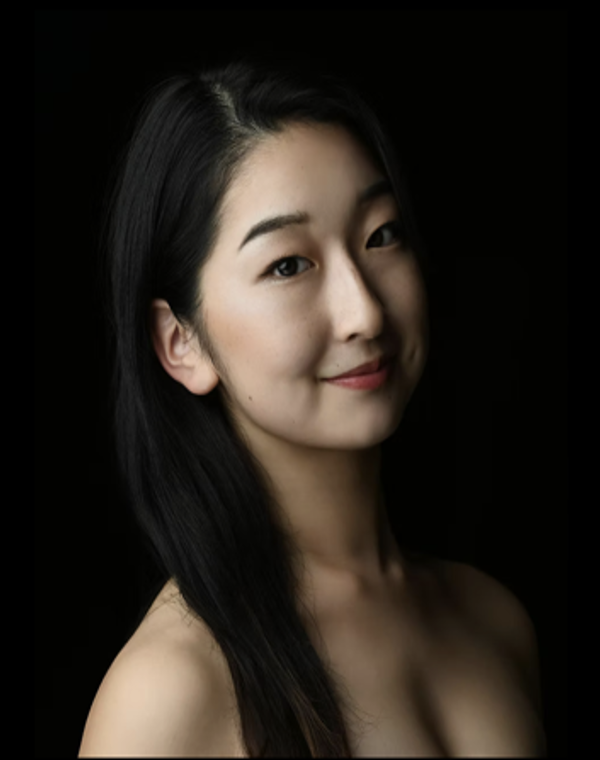
Rio Kikuchi, was born in Tokyo, Japan. At the age of 3, Rio began ballet training at Studio Benus in Japan, and later she was introduced to Tap and Jazz. She took the Summer Intensive at the Kirov Academy of Ballet in Washington DC in 2015. She also studied Ballet technique and Point work privately with Luis Villanueva. In 2017, Rio moved to New York and was offered a scholarship to study at The School of Alvin Ailey American Dance Theater. In addition, she received a scholarship at Alonzo King Lines Ballet Summer Program in 2019. She has worked with Ronni Favors, Darshan Singh Bhuller, and performed “Memora” with Alvin Ailey Dance Theater at New York City Center in 2018.
Miaotian Sun, Dancer

Miaotian is a dancer, choreographer, and interdisciplinary artist whose work creates a living dialogue between ancient lineage and contemporary inquiry. With over twenty years of training in Chinese classical and folk dance and eight years of contemporary practice, she develops a hybrid movement language that explores how bodies carry history, memory, and cultural perception. Her immersive works integrate movement, voice, sound, and visual design, often using props as symbolic anchors to investigate tension, harmony, and cross-cultural understanding.
She holds an M.A. in Dance Education from NYU and completed advanced training at Peridance NYC. A member of the International Dance Council (CID | UNESCO), Miaotian is recognized for her boundary-breaking fusion of contemporary movement and Chinese aesthetics. Her work has been featured in Women’s Journal, NewsBreak, and Broadway World.
Johnson Guo, Dancer
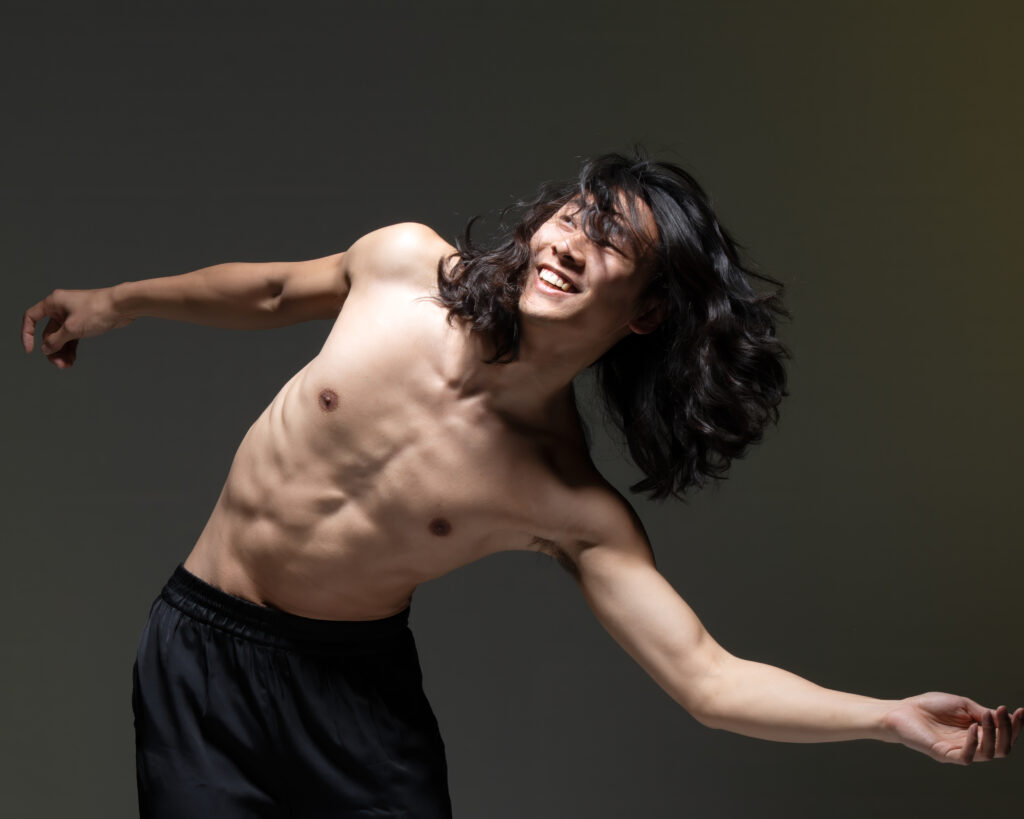
From Brooklyn, NY, Johnson began dancing at the Ballet Tech school. There, he had the opportunity to perform works by Eliot Feld, Brian Brooks, and many others at many notable theaters such as the Joyce Theater. After earning his bachelor’s of Fine Arts in dance performance at SUNY Purchase, Johnson joined the prestigious Limon Dance Company. This year is Johnson’s 5th season touring domestically and abroad with the masterworks of Limon and new commissions by choreographers such as Raul Tamez, Kayla Farrish, Diego Vega Solorza, and Aszure Barton. Alongside performing, Johnson is also pursuing choreography. In November 2025, he had a world premiere in Guangzhou, China.
Tianyu Wang, Dancer
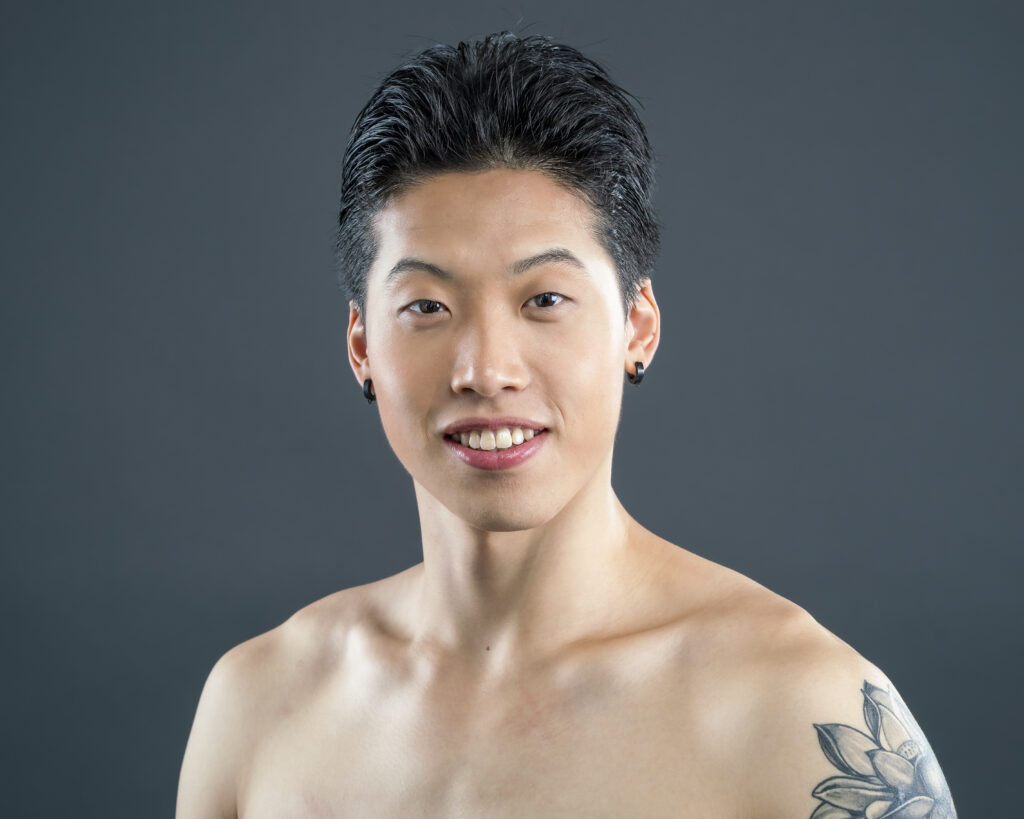
Tianyu Wang is a dancer from Beijing, China. He graduated as Student Body President of the Beijing Dance Academy’s Chinese Dance Program before moving to the United States to continue his artistic development. He earned his BFA in Contemporary Dance on a full scholarship from the University of North Carolina School of the Arts (UNCSA).
Before pursuing dance, Tianyu studied piano and competitive swimming, experiences that provided him with a strong foundation in musicality, discipline, and physicality. During his time at UNCSA, he performed works by Martha Graham, José Limón, Darrell Moultrie, Trey McIntyre, Juel Lane, Ming-Lung Yang, and others.
Tianyu is currently a company member with Peridance Contemporary Dance Company. His artistic background also includes training in Chinese Classical Dance, Chinese Folk Dance, and martial arts, which continue to inform his movement vocabulary. Now based in New York, he is dedicated to conveying resilience and perseverance through dance and seeks to build cultural bridges through performance and collaboration.
Han Chunqi, Costume Designer

Han Chunqi is the visiting professor at Beijing Dance Academy. In 1977, he graduated from the Department of Performing Arts of the Central Academy of Drama, and in 1980, he studied in the oil research class of Guangxi Academy of Arts. He is now a visiting professor of Beijing Dance Academy, a professor at Changxin International Art College of Yunnan University, a master’s supervisor, a special professor of Beijing City College, and a first-class dance designer. He has won the titles of Beijing Olympic Advanced Individual, Beijing Excellent Teacher, Famous Teaching Teacher and May Day Labor Medal.
In the past five years, the main works include the song and dance drama “Bongguan Kiln” Changsha, “Dream Back to the Tang Dynasty” in Xi’an, “Old Soldier” Enshi, the ballet “Pagoda Mountain” in Shanghai, “Dunhuang Past” Lanzhou, and the song and dance drama “Eternal Song” Yulin.
Anna Borou Yu & Jiajian Min, Multimedia Design & Creative Technology

Anna Borou Yu and Jiajian Min, create and curate multimedia artworks in the forms of installation, exhibition, film, VRAR, digital publication, performance, and immersive theater. Their works reflect on the concept of space and body throughout history in different cultures, craft embodied exhibitions in extended reality, and translate cultural heritage into contemporary interpretation with cutting-edge technology. Their works have been featured at the Venice Biennale, Arte Laguna Prize, the Ars Electronica Art Gallery, ACM SIGGRAPH Asia, IRCAM FORUM, Lumen Prize, etc. Anna and Jiajian have been the XR Track Member at NEW INC, New Museum of Contemporary Art, Judge of MIT AI Film Hack, MIT Reality Hack ICME AI Art Gallery, Reviewer of ISEA, IEEE AIART Workshop, and they have also worked with Harvard University, MIT and prestigious institutes on various digital cultural heritage and theater projects.
Website: https://mystudio.design/
CAVES OF DUNHUANG
written by Ann Walner
Professor of History, University of Minnesota
Caves of Dunhuang • Eassy by Ann Waltner
Dunhuang was an oasis along the Silk Road, a route that connected China to India in the South and to Turkey and Italy in the west. Merchants carried precious goods—silk, porcelain, musical instruments, medicines—along the Silk Road. It was the trade along the Silk Road that brought Buddhism to China. It stretched for 4,000 miles, often poor roads over isolated land, much of it desert. The oasis of Dunhuang wasa green and forested site in the midst of a vast desert, a place which attracted pilgrims, merchants, travelers and migrants. It was the main land route connecting China and Europe. Legend has it that work on the caves began in the fourth century, when a Chinese Buddhist monk named Lezun 樂僔 saw a ray of golden light in the shape of a thousand Buddhas. He took that as a sign that he was to establish caves to honor the Buddha. Lezun commissioned work on the caves; work continued on the caves until the fourteenth century. Travellers along the road deposited treasures from their own cultures in the caves. Dunhuang gained its importance as an oasis along the Silk Road; when the Silk Road fell into disuse, the city lost its prominence and the caves faded into obscurity. But the caves attracted the attention of western explorers in the early twentieth century.
The caves are important for both their art (which has inspired the performance you are seeing today) and the texts in what is known as the “Library Cave,” which was intentionally sealed in the eleventh century. We do not know for certain who sealed it or why, but many scholars believe it was to protect the treasures in the event of attack from the Kara-Khanid Khanate, which in 1006 had conquered the Buddhist kingdom of Khotan and destroyed much Buddhist art there. The Dunhuang “Library Cave” contains approximately 50,000 items, works of literature, paintings, land contracts, musical instruments and other objects too numerous to mention. Scholars do not agree on why the cave was sealed; it was perhaps to protect the items in it. The “Library Cave” was discovered in 1900 by an itinerant Chinese Daoist priest named Wang Yuanluu王圓籙. Explorers from Europe, notably Paul Pelliot and Aurel Stein, were intrigued by the library, which had myriad volumes in many languages, some of which are no longer spoken. One of the texts is a page in Syriac of the book of Psalms from the Old Testament of the Bible, dating from the Yuan dynasty (1271-1368). Another of the texts from the “Library Cave” is a poem in classical Chinese describing the stream that made Dunhuang an oasis:
This sweet spring leaps out of the earth, miraculously dit returns to the town.
A single source produces double branches, two streams pour into the same pond.
Green duckweed gathers on waves, turquoise willows hang before islets.
When I set my eyes on this beautiful scenery, all my tiredness is gone[1]
The texts were scattered, purchased by many libraries throughout the world. In 1994, it became clear to librarians and archivists that it was counterproductive to have the manuscripts scattered. So the International Dunhuang Program was initiated. It began with an agreement between the National Library of China and the British Museum. The website (https://idp.bl.uk/) contains digitized texts as well as spectacular images. In the intervening decades, a number of libraries have joined the project. It remains true that many of the spectacular items from Dunhuang remain in Western libraries and museums.
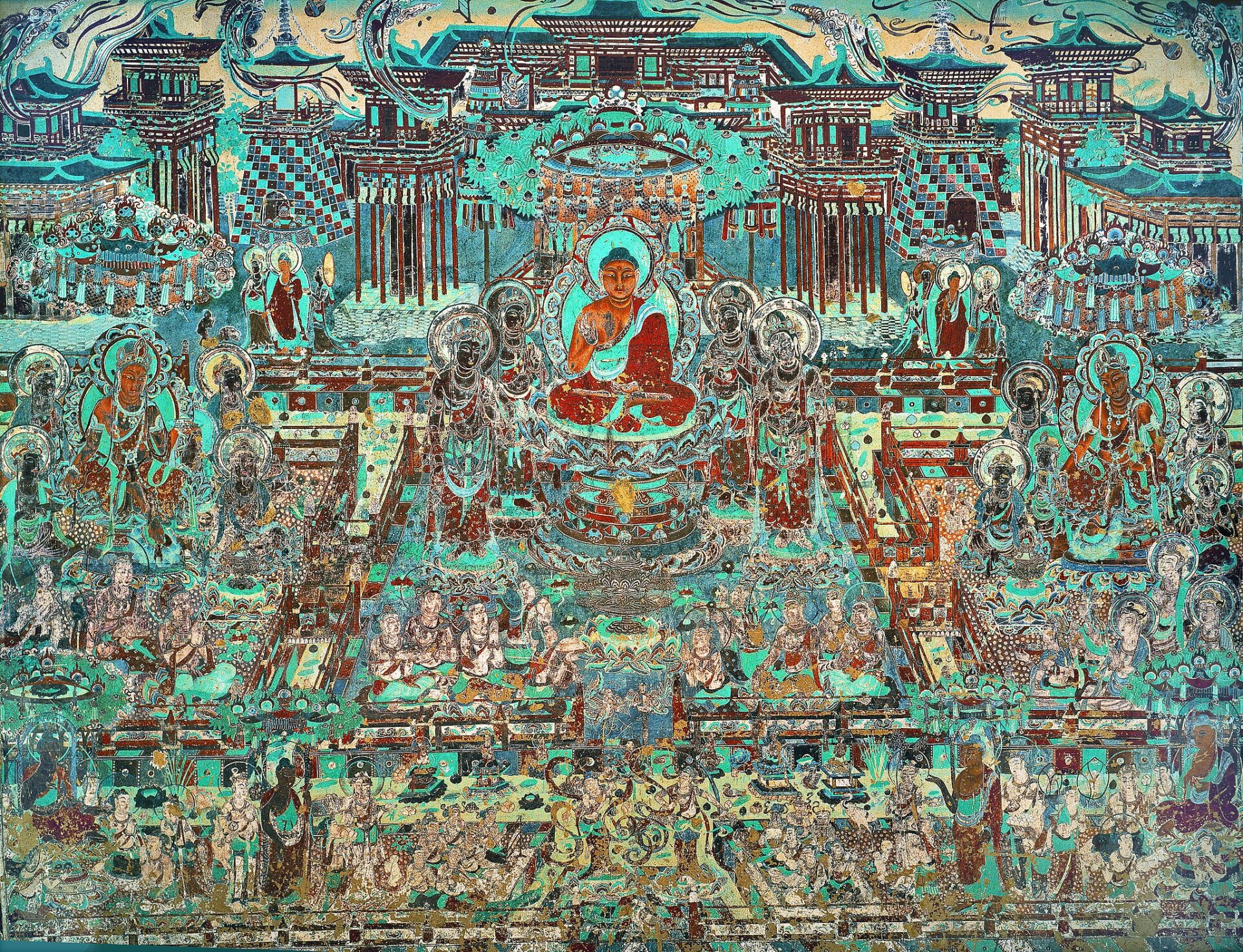
The images from Dunhuang are spectacular. Some are three dimensional statues, some are frescoes. But they are not static. Many of them show lively movement, movement which inspired the dances which you will see this evening.
Ann Waltner
Department of History
University of Minnesota
Ann Waltner is a professor in the Department of History at the University of Minnesota. Her research is on the cultural history of late imperial China. She was the founding director of the Institute for Advanced Study at Minnesota, and has served as editor of the Journal of Asian Studies.
[1] Translation from Wu Hung, Spatial Dunhuang: Experiencing the Dunhuang Caves. University of Washington Press, 2023, p. 地湧澄泉美, 還城本自奇。 一源分異泒, 兩道入湯池。 波上青頻合, 洲前翠柳垂。 況逢佳影處, 從此遂忘疲。 “Fenliu quan” 分流泉 (Divided Spring), in “Dunhuang guji ershi yong” 敦煌古跡二十詠 (Twenty songs on Dunhuang’s historical sites). DM P.2983.


PROGRAM NOTES
written by Jacob Bancks,
Professor of Music, Augustana College
ANGEL LAM • Unearthing the Heart: The Thousand Grottoes at Dunhuang
ANGEL LAM
(b. 1978)
INSTRUMENTATION:
Piccolo, two Flutes, Alto Flute, two Oboes, two Clarinets, two Bassoons, Contrabassoon, two Horns, two Trumpets, two Trombones, Tuba, Timpani, three Percussion, Harp, Piano, and Strings.
WOLRD PREMIERE PERFORMANCES

Composer Angel Lam writes:
This piece is about discovering the oasis city Dunhuang, once a “shining, blazing beacon” located at the edge of the Gobi desert and the entrance to the Taklamakan Desert, the main crossroads of the ancient Silk Road routes – the road leading from India via Lhasa to Mongolia and southern Siberia, and also the entrance to the narrow, tightly controlled Hexi Corridor which leads directly to the ancient capitals of Chang’an (today’s Xi’an) and Luoyang.
It is a scenic oasis shaped by Crescent Moon Spring and the vast, majestic Mingsha Shan (Singing Sand Dunes). Dunhuang is not only an important stop on the Silk Road; its true significance lies in being the crossroads of the human spirit.
Within the honeycombed cliffs of Dunhuang’s Mogao Caves, many generations of monks, artists, and pilgrims created a treasure trove of mural paintings and sculptures, documenting a thousand years of life and rituals on the Silk Road. Their endless pursuit of spiritual truths and enlightenment is revealed in paintings of numerous Buddhist stories and documented manuscripts. They vividly portray a place alive with East and West mingling in diversity, curiosity, and creativity.
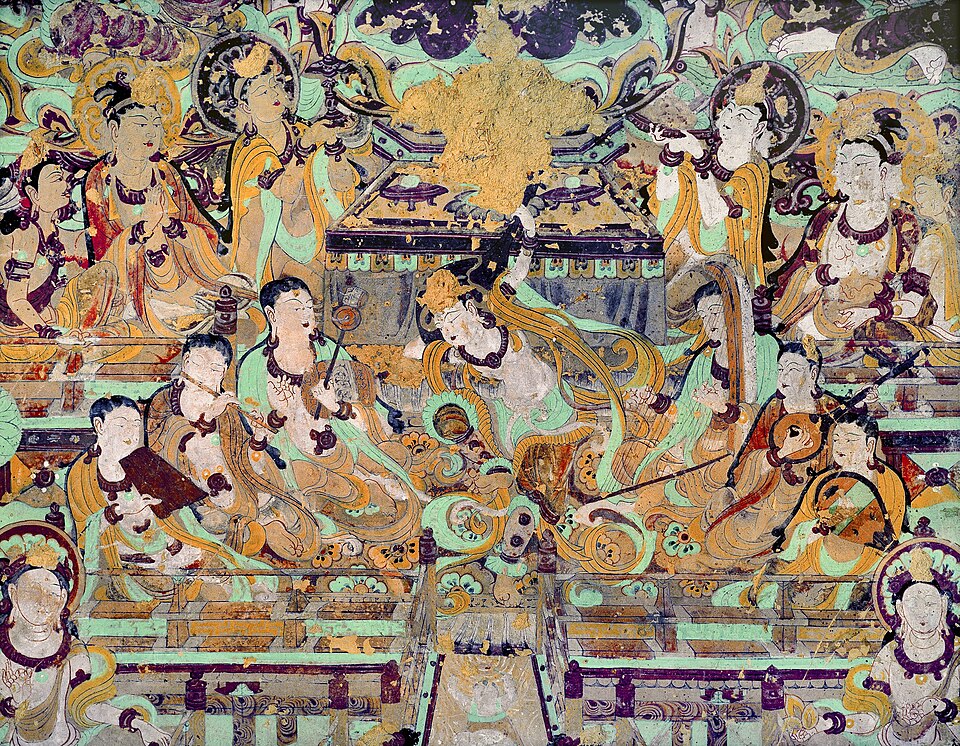
For example, in my “Reversed Pipa Dance”, it is an evocative re-creation of the renowned Grotto 112, the Music Cave. It is filled with joy, beauty, emotion, and virtuosity, as depicted in its murals. Specifically, highlighting the iconic “Reversed Pipa Musician Apsara,” where the dancer-musician places the pipa behind her head, performing it in a difficult, reversed position. A mysterious performance style now lost, but re-imagined in this movement, with its unique difficulty and radiant grace.
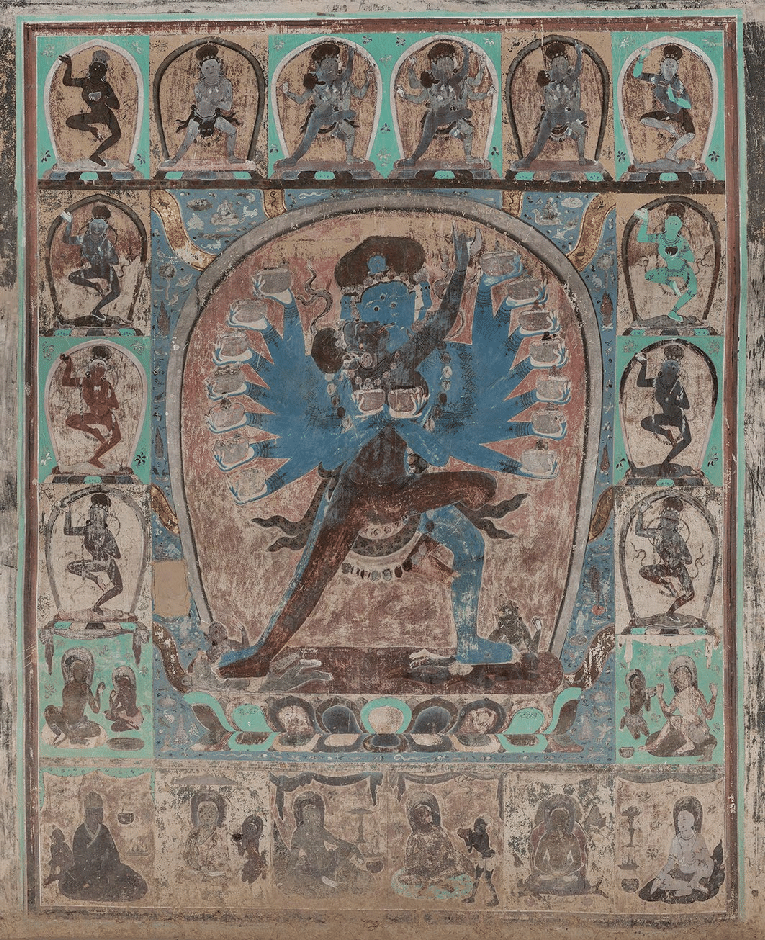
Grotto 465 depicts a powerful duet of Vajrabhairava, a wrathful deity in tantric Tibetan Buddhism, in a dance/erotic embrace with his consort Vajravetali, signifying the inseparable union of compassion and wisdom, essential for awakening.
Grotto 320 is characterized by graceful, soaring movements, flowing silks, and an ethereal quality. The movement evokes celestial beauty and effortless flight, representing the soul letting go, its ascent to Pure Lands, and a joyful reunion with the soul’s memories: past, present, and future, becoming one.
In modern times, many of us have lost our way to our hearts. We become confused by the ego and the wandering mind. But our heart, if we listen intently and quietly, holds much more knowledge. It knows so much more about humanity and other people’s lives. It knows more than what we see, hear, or touch in this life, things we often grasp too tightly just to survive. The heart is full of compassion and deeply felt resonance for humanity, no matter the race, gender, or social status. I am not religious, but discovering the grottoes at Dunhuang was an awakening for me. As well as for our choreographer Zhongmei, and her husband, Richard Bernstein, when they first set foot on the Silk Road path as China opened its western territories to the world in the 1990s. Richard Bernstein was one of the first American journalists to report on this passageway since the beginning of the 20th century.
For us, this journey opened a pathway to the heart. And most of all, a pathway to love, the soul of our human race, and what connects us all together.
IGOR STRAVINSKY • The Rite of Spring
IGOR STRAVINSKY
(1882-1971)
INSTRUMENTATION:
Piccolo, three Flutes (third doubling Piccolo), Alto Flute, four Oboes (fourth doubling English Horn), English Horn, E-flat Clarinet, three Clarinets, Bass Clarinet, four Bassoons (fourth doubling Contrabassoon), Contrabassoon, eight Horns (seventh and eighth doubling Tenor Wagner Tubas), Piccolo Trumpet, four Trumpets (fourth doubling Bass Trumpet), three Trombones, two Tubas, two Timpani players, Percussion, and Strings.
PREMIERE:
May 29, 1913, Théâtre des Champs-Élysées, Paris, conducted by Pierre Monteux.
QCSO PERFORMANCE HISTORY:
This is only the third set of performances of the Rite in QCSO history. The first was in December 1982, conducted by James Dixon, and the most recent was in March 2013, conducted by Mark Russell Smith.

“The evening was hot in every sense of the term,” wrote Parisian critic Gustave Linor, reviewing the world premiere of Le Sacre du printemps in late May 1913. “Part of the audience disturbed the spectacle with laughter, with protests and even with ‘chut!’ (i.e., ‘hush!’),” recounted Linor, “while another group countered this with every bit as much racket and in terms equally out of place. This performance came close to degenerating into a town meeting.”
What could have caused such a pandemonium among the audience? As one attendee later recounted, “We warred over art.” For one, there was the shocking and repetitive choreography devised by Vaslav Nijinsky, designed to evoke the pagan rituals of ancient Russia. “They stamp, they stamp, they stamp, and they stamp,” recounted the critic Adolphe Boschot in L’Écho de Paris. “Suddenly: they break in two and salute. And they stamp, they stamp, they stamp…” Referring to the character of the Chosen One, who ritually dances herself to death at the work’s climax, Boschot observed, “The choreographer destroys her at will… It is hideous.”
But equally shocking was the music of Nijinsky’s compatriot Igor Stravinsky, which likewise aimed to imagine the sound of pre-Christian Russian landscapes and cultures. “Give up trying to understand it, and deplore such a strange aberration,” exclaimed critic Henri Quittard, writing in Le Figaro. Labelling the work “a laborious and puerile barbarity,” he wondered why the composer would “imagine that a melody, because it is doubled a second higher or lower for fifty measures—or both at once—will gain a decisive and eloquent intensity?” He added, patronizingly, “We are sorry to see an artist such as M. Stravinsky involve himself in this disconcerting adventure.”
Years later Stravinsky himself would summarize the evening more succinctly. “They were very shocked,” he said. “They were very naïve and stupid people.”
The journey toward what would become the most infamous evening in the history of classical music began in 1906, when Russian arts entrepreneur Sergei Diaghilev brought a number of Russian paintings for exhibition in Paris. Russian artists who experienced relative public indifference in their native Russia were, with the help of Diaghilev’s creative marketing, greeted with enormous acclaim by the French public. Having created an appetite for Russian art in Paris, Diaghilev would go on to produce concerts of Russian music at the Opéra de Paris in 1907 and 1908, culminating in the revival of Modest Mussorgsky’s opera Boris Godunov, which proved to be an enormous critical and popular success. In 1909, Diaghilev would finally turn to ballet, founding the Ballets Russes (“Russian Ballet”) for the purpose of exporting Russian choreography to Paris and beyond.
Though the first performances of the Ballets Russes in Paris used mostly composites of existing Russian symphonic music and other time-worn ballet favorites, for his 1910 season Diaghilev decided to produce something unique: a new ballet on explicitly Russian themes, based on the legend of The Firebird. After some difficulty identifying a willing composer up to the task, Diaghilev met the unknown Igor Stravinsky, the son of an operatic superstar Fyodor Stravinsky and student of the highly influential Nicolai Rimsky-Korsakov. The tremendous success of Stravinsky’s Firebird in 1910 was followed by the even-more-widely acclaimed ballet Petrushka of 1911. In short, the producer Diaghilev was on a major winning streak in Paris, and the young composer Stravinsky was along for the ride, feeding the Ballets Russes a string of major artistic triumphs.
To follow Petrushka, composer and impresario hoped to dream up something even more sensational. Stravinsky claimed the idea struck him while he was finishing Firebird. “I saw in imagination a solemn pagan rite: sage elders, seated in a circle, watched a young girl dance herself to death. They were sacrificing her to propitiate the god of spring. I did not yet know the exact form of the work, but I felt that it must be expressed in music.” Crucial to realizing this vision was Stravinsky’s consultations with Russian folklorist and set designer Nicholas Roerich, who collaborated with Stravinsky on the work’s concept and designed the set and costumes for the premiere. “I have been studying Russian (and Slavic) antiquity for twenty years now,” wrote Roerich, recounting the creative process. “I wanted to present scenes of the joy of Earth and the exultation of Sky in a Slavic context.”
Stravinsky’s work on the score commenced after the premiere of Petrushka in 1911, and he fashioned the work as freely as he had conceived it. “I was guided by no system whatever in Le Sacre du Printemps,” he said years later. “I had only my ear to help me; I heard and I wrote what I heard. I am the vessel through which Le Sacre passed.”
The mayhem surrounding the work’s premiere was foreshadowed by a problematic rehearsal process. First, there was a year’s delay due to Diaghilev’s overscheduled 1912 season, especially related to his difficulties preparing another complicated commission, Maurice Ravel’s Daphnis et Chloe. Then there were conflicts between composer and choreographer: Nijinsky, who had himself performed the title role of Petrushka, was consistently behind schedule, and Stravinsky detested the choreography Nijinsky designed for The Rite. When conductor Pierre Monteux had Stravinsky play through a piano version of his score, he was shocked. “Before he got very far, I was convinced he was raving mad,” Monteux later recounted. “My only comment at the end was that such music would surely cause a scandal.”
Yet despite a turbulent process of creation and a riotous initial public reception, it turns out that for Stravinsky all publicity is good publicity. The Rite of Spring turned out to be the ultimate succès de scandale, vaulting the composer to international notoriety and instantly making him a cornerstone figure in musical modernism. Within a few years of its premiere, his work soon entered the orchestral repertoire and was widely performed in Europe and the United States. It became clear that Le Sacre du printemps had moved from being a riot-inducing shocker to a staple of the classical mainstream when Walt Disney, in his 1940 music appreciation film Fantasia, included portions of Stravinsky’s work to depict an ancient dinosaur landscape.
LISTENING GUIDE
Part One: The Adoration of the Earth
Introduction
- Timbre: This is it, the legendary high bassoon solo that has since changed how the instrument was played and studied! Note how careful Stravinsky is with the accompanying instruments.
- Rhythm: This opening section, which was not choreographed, has a nearly-imperceptible beat.
The Augurs of Spring: Dances of the Young Girls
- Harmony: You will know the curtain is up when you hear striking, repeated chords and the beat is suddenly perceptible. A composite of two dominant seventh chords a half-step apart, this “Augur chord” went on to play an important role in twentieth century music.
Ritual of Abduction
- Texture: Crashing timpani and sudden panicking vibe with many distinct layers leads to this brief section which sounds exactly like its title.
Spring Rounds
- Melody: This haunting section is permeated by a haunting and plaintive melody which is often played in unison between instruments widely separated in register.
- Timbre: The passage climaxes with a crash on the tam-tam, towering dissonances and excruciating trombone glissandos.
- Tempo: After a brief interlude of faster tempo, the passage concludes with a recap of the slow, plaintive melody.
Rival Tribes/Procession of the Sage
- Timbre: The timpani announces this brutal but jubilant passage, with near-joyful interjections by the winds and strings.
- Rhythm: The tempo stays steady through the “Procession of the Sage”; you will know he is processing when you hear a metallic, driving undercurrent.
The Sage
- Tempo: A very brief, suddenly slow, and dark passage depicts a wise old elder of the tribe.
Dance of the Earth
- Rhythm: The first part of the ballet concludes with a general dance, featuring short, repeated rhythmic motives throughout the orchestra, and especially in the trumpets.
Part Two: The Sacrifice
Introduction
- Texture: Haunting, drifting chords at a moderate tempo in the woodwinds and horns begin the lengthy introduction to the ballet’s second half, with eerie and quiet interjections.
Mystical Circles of the Young Girls
- Timbre: You will know the Young Girls have formed their Mystical Circles when you hear a strange combination of six solo violas, followed by a low alto flute solo.
Glorification of the Chosen One
- Harmony: We hear eleven, slow, brutal strikes of a low chord to usher in the Glorification of the Chosen One.
- Melody: The Chosen One is apparently glorified by a repetitive and intense gesture in the high woodwinds.
Evocation of the Ancestors
- Tempo: The Ancestors are evoked only briefly, marked with a slight moderation of the tempo.
Ritual Action of the Ancestors
- Rhythm: The tempo remaining moderate, a sinister repetitive accompaniment figure provides a background for slinky woodwind solos.
- Timbre: A grotesque and very quiet bass clarinet solo brings this section to an end.
Sacrificial Dance
Rhythm: The iconic final Sacrificial Dance is a proving-ground for conductors; the meter (time signature) changes almost constantly, and in unpredictable patterns. Though this passage has the sound of a typical concluding “danse generale” (wherein we would expect to see the whole ballet company performing), this music was designed as a “dance to the death” for a single dancer.