

PROGRAM NOTES
ARTIST BIOGRAPHIES
Wei Luo, piano
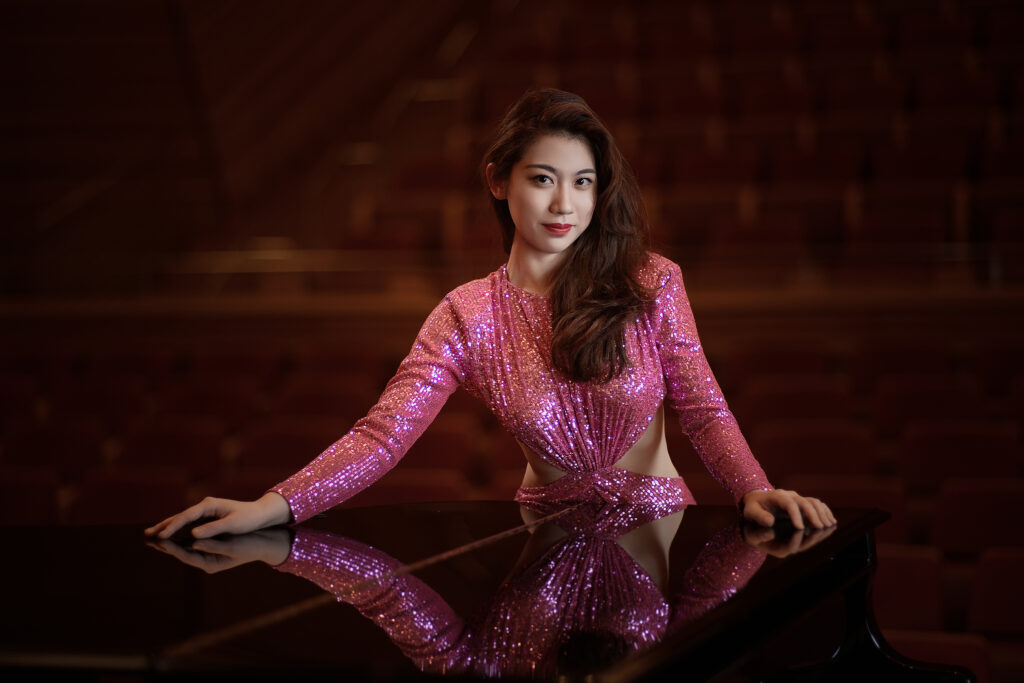
Hailed by the San Diego Union-Tribune as “destined for stardom,” Wei Luo is widely recognized as one of the most exciting pianists of her generation. A graduate of the prestigious Curtis Institute of Music, where she studied with Gary Graffman and Robert McDonald, Luo has garnered acclaim for her commanding technique, emotional depth, and adventurous programming. At just 17, she signed with Universal Music Group, releasing her critically acclaimed debut album Wei Luo, which drew praise from Gramophone and other international publications. That same year, she was awarded the Gilmore Young Artist Award, one of the most prestigious honors for young pianists.
Her prodigious rise began early, winning top prizes at the Chopin International Youth Piano Competition (Poland) and the Rachmaninoff Youth Piano Competition (Germany) at age 11, and performing Prokofiev’s Piano Concerto No. 3 with the Shanghai Philharmonic Orchestra at the season-opening concert under conductor Tang Muhai.
Named one of 19 “Artists to Watch” by New York’s classical station WQXR, Luo was appointed a Steinway Artist in 2023 and released Gaze (《凝望》) through the National Centre for the Performing Arts label. The album was included in Apple Music’s Top 100 Songs of 2023 and won QQ Music’s Classical Album of the Year. Her national recital tours—including Gaze: East, Songs of Ice and Fire, and At the Break of Dawn—have reached over 50 cities across China.
Recent highlights include solo appearances at the 2024 Beijing and NCPA New Year’s Concerts, and the 2025 China Philharmonic New Year’s Concert under Yu Long. Luo also performed at the Ministry of Foreign Affairs’ Diplomatic Reception Concert, and toured Russia with the NCPA Orchestra for the 75th anniversary of China–Russia relations, performing Tchaikovsky’s Piano Concerto No. 1 in sold-out concerts in Moscow, St. Petersburg, and Vladivostok.
Luo has appeared as a soloist with major orchestras including the San Diego Symphony, Minnesota Orchestra, Orlando Philharmonic, Shanghai Symphony, China Philharmonic, and Guangzhou Symphony, among others. She has performed under leading conductors such as Michael Stern, Jahja Ling, Mark Russell Smith, Yu Long, Lu Jia, Zhang Guoyong, and Li Xincao, and has graced stages across North America, Europe, and Asia.
A passionate collaborator and multi-disciplinary artist, Luo has performed at high-profile events such as the “Time’s Friend” New Year’s Eve broadcast on Shenzhen TV, viewed by over 100 million people. She is also a poet, visual artist, and filmmaker—her debut short film The Keys, which she wrote, produced, and starred in, wrapped filming in 2025. Luo’s cross-genre collaborations include partnerships with luxury brands such as Chopard, Chloé, A. Lange & Söhne, and Steinway.
In 2025, she serves as Artist-in-Residence with the Shenzhen Symphony Orchestra, performing and recording four Russian piano concertos for release by Tencent Music Group.
PROGRAM NOTES
written by Jacob Bancks,
Professor of Music, Augustana College
PYOTR ILYICH TCHAIKOVSKY • Polonaise from Eugene Onegin
PYOTR ILYICH TCHAIKOVSKY
(1840-1893)
INSTRUMENTATION:
2 Flutes, 2 Oboes, 2 Clarinets, 2 Bassoons, 4 Horns, 2 Trumpets, 3 Trombones, Tuba, Timpani, and Strings.
PREMIERE:
March 29, 1879, performed by students from the Moscow Conservatory, conducted by Nicolai Rubenstein, Maly Theatre, Moscow.
QCSO PERFORMANCE HISTORY:
Ludwig Becker led two performances of the Polonaise early in the Tri-City Symphony’s history, in 1924 and 1927. It then took a long hiatus from the repertoire, reemerging only in 2004 at a special concert. Mark Russell Smith conducted the work’s most recent local performance in 2008.
The Russian writer Alexander Pushkin (1799-1837) is as foundational to Russian literature as William Shakespeare is to English. And as Russian nationalism in music rose in the decades following Pushkin’s death, many composers turned to him for inspiration. A prominent early example was in 1842, when Mikhail Glinka adapted Pushkin’s Ruslan and Lyudmila to the operatic stage, and later operas based on Pushkin included Modest Mussorgsky’s Boris Godunov of 1874, Nicolai Rimsky-Korsakov’s The Golden Cockerel of 1909, and Igor Stravinsky’s Mavra of 1922.
Arguably, however, no Russian composer was as devoted to Pushkin as Pytor Ilyich Tchaikovsky. Writing to his brother Modest in 1877, Tchaikovsky asserted, “Pushkin is a poet of universal genius, and there is nothing in European literature comparable to him in combination of lyric, narrative, and dramatic power.” In addition to writing several songs on Pushkin texts, Tchaikovsky turned frequently to Pushkin’s work for operatic inspiration, and his two most-often performed operas are both based on Pushkin tales: Eugene Onegin (1879) and The Queen of Spades (1890).
“Onegin is a perfect work in every sense,” he asserted in a letter to his patroness Nadezhda von Meck. “Pushkin has revealed the inner life of his characters with astonishing subtlety and psychological insight.” The story revolves around a young woman’s unrequited love for a dashing but impetuous young man, and how his errors in judgment alter the courses of both of their lives. The opera’s first two acts are set in the countryside among the Russian aristocracy, and Act II closes with a duel between Eugene Onegin and his former friend, Lensky. In an eerie premonition of Pushkin’s own death by duel, Lensky is killed by Onegin.
The opening of Act III presents Tchaikovsky the dramatic challenge of moving his audience to a drastically different time (years later, with older and wiser characters) and place (the grand society of St. Petersburg, in contrast to the bucolic countryside of Acts I and II). Tchaikovsky accomplished this task by writing a noble Polonaise, a type of Polish dance long associated with formal, aristocratic occasions. Echoing the tremendous success of Tchaikovsky’s opera, the Polonaise has been frequently performed ever since as a concert and ceremonial work.
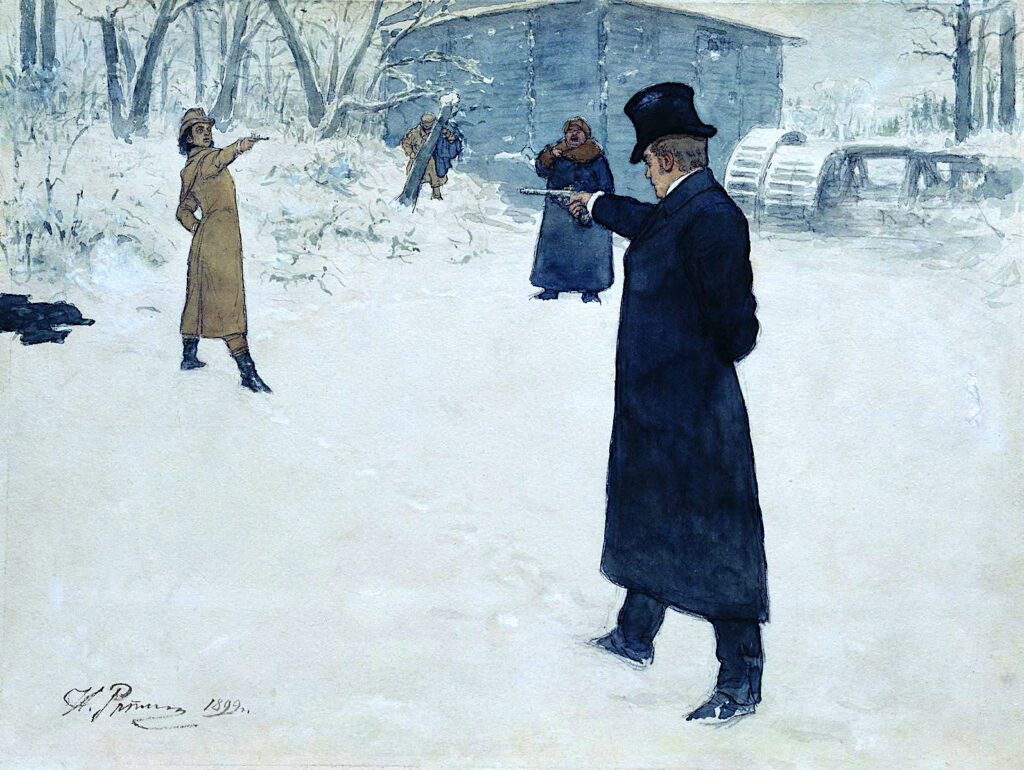
Ilya Repin (1844–1930), Eugene Onegin and Vladimir Lensky’s duel, 1899.
LISTENING GUIDE
RHYTHM:
The Polonaise is a moderate dance in triple time, with three beats per bar.FORM:
Like most dance movements, this polonaise has a “trio” section, where the music relaxes and Tchaikovsky is clearly pointing to dramatic intrigue and even conflict.INSTRUMENTATION:
Though most of the work has forceful melodies doubled between the violins and upper woodwinds, a good part of the trio includes a lovely melody doubled between the cellos and first bassoon.
EDVARD GRIEG • Piano Concerto in A minor, Op. 16
EDVARD GRIEG
(1898-1937)
INSTRUMENTATION:
2 Flutes, 2 Oboes, 2 Clarinets, 2 Bassoons, 4 Horns, 2 Trumpets, 3 Trombones, Timpani, and Strings.
PREMIERE:
April 3, 1869, Holger Simon Paulii conducting, Edmund Neupert as soloist, Casino Theatre, Copenhagen, Denmark.
QCSO PERFORMANCE HISTORY:
Judging by programming history, Grieg was one of Ludwig Becker’s favorite composers. Prominent pianist and composer Myrtle Elvyn performed Grieg’s concerto on the Tri-City Symphony’s second-ever concert in 1916, conducted by Becker. University of Iowa School of Music director Philip Greeley Clapp next performed the work at a 1920 run-out concert in Iowa City, also conducted by Becker. Becker’s last full performance of the concerto was in 1924 with soloist Margaret Farr, though he collaborated with student concerto competition winner Clara Reese performing second and third movements in 1932. In 1948, well-known Czech-American pianist Rudolf Firkušný performed the work here with Oscar Anderson on the podium, and pianist Ivan Davis played with James Dixon conducting in 1970. Dixon again led a performance in 1991 with soloist Santiago Rodriguez. Soloist Charlie Albright played Grieg in 2017, conducted by Mark Russel Smith. And, as if to complete the unfinished business of 1932, student concerto competition winner Quentin Fonseca performed the concerto’s first movement only in 2022, at the QCSO’s annual Side-By-Side Concert.

A photograph of a young Edvard Grieg
While today we view Scandinavia as a conglomeration of equally-advanced and modernized societies, such was not the case when composer Edvard Grieg emerged as the international voice of Norwegian music. During Grieg’s childhood, Norway’s economy was mainly the work of small fishermen and farmers, whereas nearby Denmark’s middle class was far larger and already ascendent. Oslo, then called Christiania, had a population barely topping 50,000 (i.e., not much larger than Moline in 2025) served by rather limited utilities and infrastructure. In contrast, Copenhagen had already benefitted from trends in modern urban planning and was nearing 200,000 souls (i.e., roughly the size of Des Moines in 2025).
Thus, though Grieg’s heart was always in his native Norway, he knew he had to build the foundation of his career abroad, where cultural institutions were more well-established and public appetite for concert music was stronger. He began this process by leaving home to study in the Leipzig Conservatory at age 19, and after concluding his studies in 1866, he moved to Copenhagen. It was there that he composed what would become his most important work, the Piano Concerto in A minor. Writing to his friend Rikard Nordraak prior to the work’s premiere, he claimed that “I have tried to write something that is Norwegian in spirit, yet capable of standing in the European tradition. I hope it may speak for my country.”
Notice his hope was to speak for Norway, and not necessarily to Norway. Anticipating that tastes for a Norwegian-flavored Romantic concerto would be greater abroad than at home, Grieg scheduled his concerto’s premiere in Copenhagen in April 1869, where the work was tremendously successful. But Norwegian audiences, who first heard the concerto the following summer, were less impressed. In a letter to his mother in 1869, Grieg recounted that the piano concerto “was not well received in Norway at first; they did not understand the concerto form, though Copenhagen responded warmly.”
Certainly, Grieg would come to be revered in his native country in due course, eventually receiving the honor of membership the prestigious Order of St. Olav from the King of Norway in 1887. Today he is, both inside and outside of Norway, the undisputed national icon of Norwegian music. But that he first sought training, performances and recognition abroad speaks to the still-emerging state of his native country during the early days of his career, and demonstrates that Grieg’s nationalism was built first as a showcase to the wider world and only later touched the hearts of his fellow Norwegians.
LISTENING GUIDE
First movement: Allegro molto moderato
TEXTURE:
The cascading chords that open Grieg’s concerto are famous; notice, though how Grieg prepares his audience for this audacious gesture. He begins with a thunderous timpani roll, and the entire orchestra joins the piano on its first chord.
INSTRUMENTATION:
In the middle passages of this movement Grieg wrote several poignant melodic interchanges between the flute and horn.TIMBRE:
Aside from demonstrating extraordinary virtuosity, Grieg’s first-movement cadenza also showcases some rather unusual piano colors; note in particular the gently rumbling runs in the lowest registers that sound almost gong-like.
FORM:
Notice how elegantly and efficiently Grieg connects the quiet end of the cadenza to the reprise of the opening crashing-chord motive to end the movement.
Second movement: Adagio
HARMONY AND TIMBRE:
In a move not atypical for Romantic concertos, Grieg places the opening of the second movement in a key – D-flat major – that is extremely “remote” from the first movement’s key of A minor. This means that the two keys have very few shared pitches; additionally, A minor is a highly resonant key in strings, whereas D-flat minor makes little use of open strings and is therefore much mellower in color. And to warm things up even more, Grieg has the strings play with mutes. The contrast from the first movement could not be clearer.
MELODY:
The main tune in the second movement is one of the great Romantic melodies. Played quietly it sounds like a solemn prayer; as Grieg increases the volume, it becomes a passionate cry.
Third movement: Allegro moderato – Allegro animato
FORM:
Rather than a single, long cadenza, Grieg includes brief cadenza-like passages throughout this movement.
MELODY AND INSTRUMENTATION:
First introduced by the solo flute, this movement contains another heartfelt melody; the piano takes it up almost immediately; notice how Grieg has a single cello help hold down the piano’s bass line during this emotive passage.
FORM:
Following this melody, one might be tempted to believe that this concerto ends quietly; but from a showbusiness point of view, this would never do. From near-silence, Grieg draws us back into the quicker, forward-driving tempo to the concerto’s triumphant A major conclusion.
JOHANNES BRAHMS • Symphony No. 2 in D major, Op. 73
JOHANNES BRAHMS
(1833-1897)
INSTRUMENTATION:
2 Flutes, 2 Oboes, 2 Clarinets, 2 Bassoons, 4 Horns, 2 Trumpets, 3 Trombones, Timpani, and Strings.
PREMIERE:
December 30, 1877, Vienna Philharmonic, Hans Richter conducting, in the Goldener Saal of the Musikverein, Vienna, Austria.
QCSO PERFORMANCE HISTORY:
The Tri-City Symphony performed the first movement of Brahms Symphony No. 2 in 1931 and 1932, both conducted by Ludwig Becker. Beginning in the mid-1940s, full performance were conducted by music directors Oscar Anderson (1944, 1948), Charles Gigante (1958) and James Dixon (1966, 1985, 1977). Guest conductor Alfred Gershfeld led performances in 1998, and the work was last performed by the QCSO in 2014, conducted by Mark Russell Smith.
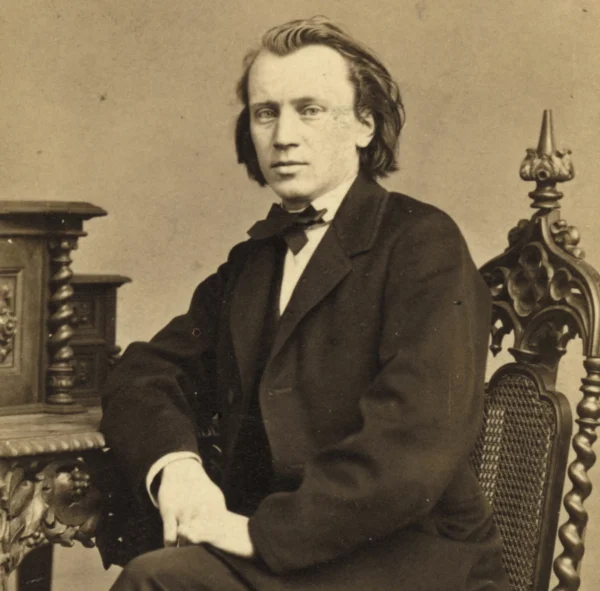
Johannes Brahms
In the autumn of 1877, composer Johannes Brahms was on the hunt. After a productive summer in the Alps, he had finished his Symphony No. 2 in October and sought a venue for its premiere before the year’s end. Though he had jokingly taunted his publisher by describing his new work as “so melancholy that you will not be able to bear it,” the symphony was actually an uplifting and friendly work that Brahms believed audiences and critics would love. First looking to Leipzig and conductor Carl Reinecke, Brahms ultimately found the prestigious Gewandhaus Orchestra’s schedule overbooked. He also may have had hesitations about the public in Leipzig, some of whom had hissed during the Leipzig premiere of his Symphony No. 1 earlier that year. Ultimately his friend and champion, conductor Hans Richter, agreed to premiere the work with the Vienna Philharmonic in early December. “This one is not like the First; it is lighter in spirit,” he again wrote his publisher, this time in all seriousness. “I hope it will please the Viennese.” The premiere was set for December 9, 1877.
But even in Vienna trouble was brewing. The city had recently been hit with a wave of Wagner fever, and by December the musicians of Vienna Philharmonic, who also served as the pit orchestra for the Vienna Court Opera, were busy. They and their principal conductor, Hans Richter, were in the throes of preparations for a January performance of Wagner’s Das Rheingold, and the musicians were concerned about having sufficient time to prepare both works.
As is often the case, this was an issue of both overwork and politics. The Viennese public, and especially the press, had separated themselves into warring factions, pitting Wagner and Brahms against each other. Some viewed Wagner’s music as bizarre and ugly, and saw Brahms as a defender of tradition and aesthetic values; others considered Brahms pedantic and regressive, in contrast to Wagner the bold innovator. The composers themselves were more subtle in their criticism; Brahms told friends he occasionally admired Wagner’s music “from afar”, and Wagner once told his wife he considered Brahms “a talented fellow, but without particular significance.” At any rate, Richter and his musicians were probably not eager to exacerbate the rivalry by performing a subpar premiere of Brahms’s new symphony due to the rehearsal demands of a Wagner opera.
The solution was to move the Brahms premiere from December 9 to December 27. This delay was likely welcomed by Brahms, who gave extraordinary care to how his music was publicly presented, and he certainly would have preferred to yield rehearsal time to Wagner rather than suffer an underprepared premiere of his own work.
Ultimately the premiere of Symphony No. 2 was a success, and audiences ever since have noted the work’s amiable and accessible quality. In a January review, Brahms’ most prominent cheerleader-critic Eduard Hanslick recounted that the premiere “was a great, unqualified success. Seldom has there been such a cordial public expression of pleasure in a new composition.” In contrast to Brahms’s first symphony, which Hanslick characterized as a work for experts, the second “extends its warm sunshine to connoisseurs and laymen alike. It belongs to all who long for good music, whether they are capable of grasping the most difficult or not.”
LISTENING GUIDE
First movement: Allegro non troppo
ORCHESTRATION:
The opening of the symphony is, in terms of orchestration, almost shocking in its modesty. Unlike Grieg, who had everyone in the orchestra playing a forceful chord by measure 2, Brahms reveals his orchestra elegantly and gradually: the cellos and basses invite the horns, who welcome the bassoons, over whom the clarinets and flutes enter almost undetected. The violins and violas enter in solemn octaves, and lead a slow dissolve into a single, near-silent timpani note.FORM:
Having unfolded his entire orchestra, the violins reveal an unexpectedly sunny melody, which precipitates a dynamic cascade to the symphony’s first assertive moments. We are finally on our way.MELODY:
This movement’s second theme recalls the famous Wiegenlied, or “Brahms’s Lullaby.” This was not an unusual gesture for Brahms, who would occasionally incorporate melodies from his songs into his instrumental works (such as the glorious cello solo in the slow movement of his Piano Concerto No. 2).
Second movement: Adagio non troppo
INSTRUMENTATION:
The cello section sits in the melodic driver’s seat for much of this movement, particularly in the opening statement of the solemn first theme.MELODY:
Aside from the frequent restatements of the cello’s opening melody, listen throughout for how Brahms creates contrast by transforming a very simple, five-note descending scale in a wide variety of contexts.
Third movement: Allegretto grazioso (quasi andantino)
ORCHESTRATION:
Brahms creates a warm and welcoming atmosphere at this movement’s opening with the woodwinds and horns; in contrast to their long melodic lines, he places below a simple, steady pizzicato accompaniment in the cellos.
Fourth movement: Allegro con spirito
MELODY:
At the movement’s opening and elsewhere throughout, Brahms has all the strings slide their way through a quick but quiet unison melody (i.e., everyone playing the same thing in their own octave, with no explicit harmony or accompaniment). He marks these passages sotto voce, literally “under the voice.”