

PROGRAM NOTES
ARTIST BIOGRAPHIES
Emily Nash, Violin
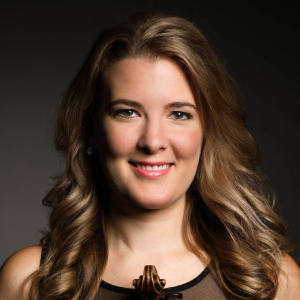
Violinist Emily Nash, graduated with her MM in violin performance while studying with Almita and Roland Vamos at Northwestern University, graduating early and with high honors. She received her BM in violin performance from the University of Illinois at Urbana-Champaign while studying with Simin Ganatra. Nash has shared the stage with Yo-Yo Ma, Itzhak Perlman, Emanuel Ax, Renee Fleming, The Eagles, Halsey, Sigur Ros, Johnny Mathis, Bobby Weir, Andrea Bocelli, and Game of Thrones composer, Ramin Djawadi.
Nash was awarded the Farwell Award from the Musicians Club of Women Scholarship Competition, was a First Prize winner in both the Greenwich Center for Chamber Music Competition and the Greater New Haven Youth Orchestra Concerto Competition. Other awards that Emily has received are the School of Music Scholarship Recipient at Northwestern University, the
Talented Student Scholarship Recipient at the University of Illinois, awarded Honorable Mention for the Carlson-Horn Competition for Young Instrumentalists, Special Recognition in Instrumental Music Award for the Shoreline Arts Alliance Competition, and received a Scholarship Award from the Friends of Morgan Music Scholarship.
Emily was the Civic Orchestra of Chicago’s Concertmaster from 2012-2013, and upon Yo-Yo Ma’s request, she was a mentor for the Artistic Challenge Project in 2014. This is Nash’s ninth season in the Quad City Symphony Orchestra where she serves as the Associate Concertmaster. Emily also recently received tenure with the Sinfonietta Orchestra of Chicago. Emily has also subbed with the Nashville Symphony, Hawaii Symphony, Milwaukee Symphony, Chicago Philharmonic, Fort Wayne Philharmonic, Illinois Philharmonic, Chamber Music on the Fox, Lake Forest Symphony, and the Midwest Mozart Festival. Emily is a founding member of the Cloud Gate String Quartet. Along with performing, Emily maintains a small private violin studio and has been an adjunct faculty member of the Vandercook College of Music. Emily resides in a Chicago suburb with her seven-year-old daughter, Natalie, and husband and violist, Bruno Vaz da Silva.
Violinist Emily Nash, graduated with her MM in violin performance while studying with Almita and Roland Vamos at Northwestern University, graduating early and with high honors. She received her BM in violin performance from the University of Illinois at Urbana-Champaign while studying with Simin Ganatra. Nash has shared the stage with Yo-Yo Ma, Itzhak Perlman, Emanuel Ax, Renee Fleming, The Eagles, Halsey, Sigur Ros, Johnny Mathis, Bobby Weir, Andrea Bocelli, and Game of Thrones composer, Ramin Djawadi.
Nash was awarded the Farwell Award from the Musicians Club of Women Scholarship Competition, was a First Prize winner in both the Greenwich Center for Chamber Music Competition and the Greater New Haven Youth Orchestra Concerto Competition. Other awards that Emily has received are the School of Music Scholarship Recipient at Northwestern University, the
Talented Student Scholarship Recipient at the University of Illinois, awarded Honorable Mention for the Carlson-Horn Competition for Young Instrumentalists, Special Recognition in Instrumental Music Award for the Shoreline Arts Alliance Competition, and received a Scholarship Award from the Friends of Morgan Music Scholarship.
Emily was the Civic Orchestra of Chicago’s Concertmaster from 2012-2013, and upon Yo-Yo Ma’s request, she was a mentor for the Artistic Challenge Project in 2014. This is Nash’s ninth season in the Quad City Symphony Orchestra where she serves as the Associate Concertmaster. Emily also recently received tenure with the Sinfonietta Orchestra of Chicago. Emily has also subbed with the Nashville Symphony, Hawaii Symphony, Milwaukee Symphony, Chicago Philharmonic, Fort Wayne Philharmonic, Illinois Philharmonic, Chamber Music on the Fox, Lake Forest Symphony, and the Midwest Mozart Festival. Emily is a founding member of the Cloud Gate String Quartet. Along with performing, Emily maintains a small private violin studio and has been an adjunct faculty member of the Vandercook College of Music. Emily resides in a Chicago suburb with her seven-year-old daughter, Natalie, and husband and violist, Bruno Vaz da Silva.
Sabrinta Tabby, violin
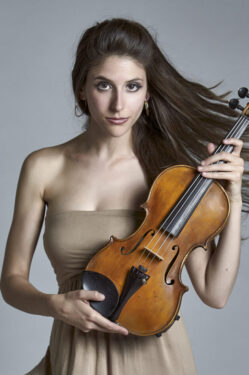
Since performing at Carnegie Hall as a teenager, violinist Sabrina Tabby has gone on to perform in the world’s top venues, from Red Rocks Amphitheater to the Grand Ole Opry. She is a founding member of the genre-defying string quartet ATLYS whose music has garnered over 30 million streams worldwide, and a founding member of the NYC-based new music ensemble Contemporaneous whose debut at LA’s Disney Hall last season was listed as one of “the best classical music performances” by the New York Times. In addition to her position in the QCSO, Sabrina is the Concertmaster of the Mankato Symphony (MN), and the Assistant Concertmaster of the Owensboro Symphony (KY). This past season, Sabrina appeared as a soloist with the the National Symphony of Paraguay, the Vanderbilt Blair Orchestra, and the Sheboygan Symphony. In her current hometown of Nashville, she is a sought-after session musician and has also recorded on hundreds of remote sessions from her home studio spanning albums to motion pictures. Her solo performance is prominently featured in the opening credits of award-winning documentary Buried: The 1982 Alpine Meadows Avalanche by Julian Scherle as well a trailer for 2024 Blockbuster Lee starring Kate Winslet, scored by Juan Dussán.
PROGRAM NOTES
written by Jacob Bancks,
Professor of Music, Augustana College
JOHANN SEBASTIAN BACH • Concerto for Two Violins in D minor, BWV 1043
JOHANN SEBASTIAN BACH
(1685–1750)
INSTRUMENTATION:
Two solo violins, strings, and continuo.
PREMIERE:
Unknown
QCSO PERFORMANCE HISTORY:
These are the first Masterworks performances of the Bach double. The slow movement was performed on a 2011 chamber series concert, conducted by Mark Russell Smith.
When we hear a piece of classical music in concert, there are a certain number of facts we can usually expect to know to aid our understanding. Aside from the work’s title and composer, information about the premiere performances is typically readily available; often we have documentary evidence, like letters from the composer discussing the work while in progress or reviews of early performances, that help us understand the work in its original context.
Yet often when hearing works from before the year 1800, much of the typical information is missing. With plenty of exceptions, we don’t know the process that led to the completion of many well-known musical works from the seventeenth and eighteenth centuries, nor do we have any reliable information about how they were premiered or received. These gaps are not simply due to lost evidence; more importantly, they show how patterns of creation and consumption of music changed enormously with the Industrial Revolution.
Before about 1780, what we now call classical composers were employed members of royal households or ecclesial courts, and their music was essentially the sophisticated background soundtrack of aristocratic life. With some exceptions, it was simply not that important in most cases for Bach to write down what year he wrote a piece, or when it was first played, or who the first performers were. While we can make educated guesses (e.g., we know St. Matthew Passion premiered on Good Friday at St. Thomas Church in Leipzig), clear evidence on the exact years and performers is often inconclusive (It was 1729! Or was it 1727?). And musicians from the era might even be a bit bewildered as to why we are even wondering about such details.
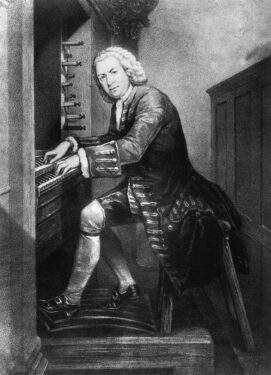
Bach’s double violin concerto is one such work where documentary evidence is essentially non-existent. Some historians date the creation of the work to his years of service to the Prince of Köthen (1717-1723), pointing out its similarities to the well-known Brandenburg Concertos he wrote there; others point out that the only surviving manuscript dates from 1730 while he was in Leipzig, and posit that the work was written for performance by Bach’s Collegium Musicum, performing regularly at Zimmermann’s Coffee House. Aside from that dispute, we have no record of the work’s performance, nor how Bach participated in the performance, either as violin soloist or conducting from the keyboard.
One thing we do know for certain is that Bach eventually took the double violin concerto and repurposed it as a concerto for two harpsichords. This involved transposition (the original D minor for violins became C minor for harpsichords) and the adding of left-hand parts, while preserving the violin melodies in the soloists’ right hands. He also accounted for the harpsichord’s lack of sustaining power by adding trills and other ornamentation.
This creation of a “new” work from existing material again reveals a difference in the evolution of classical music culture from the eighteenth to the nineteenth century. While occasionally later composers would make alternative versions of their pieces, this became much less common. Paradoxically, the aristocratic age of poor documentation was also a time of great improvisation and musical flexibility, and the nineteenth-century development of middle-class concert culture and more precise historical documentation led to less adaptability and less freedom in instrumentation.
LISTENING GUIDE
First movement: Vivace
- Texture: As soloists for baroque concertos were often the principal player of a section, Bach indicates that the solo parts should play along with the first and second violin sections for passages of the concerto. This leads to the effect of the solos “emerging” from the orchestra, rather than standing in contradistinction to it.
Second movement: Largo ma non tanto
- Melody: This movement is full of glorious imitative melodies, where one of the soloists begins a line and the other echoes a measure later, often in a different key. Notice also how the melodies move almost inexorably downward. This imbues the less-common and more gradual ascending melodic figures with a special emotional punch.
Third movement: Allegro
- Rhythm: The rhythmic intensity of this movement is heightened by occasional use of sixteenth-note triplets in the solo parts. You will notice a sudden burst of energy from the soloists and a brief stepping-back by the orchestra.
GUSTAV MAHLER • Symphony No. 6 in A minor
GUSTAV MAHLER
(1860-1911)
INSTRUMENTATION:
5 flute/piccolo players (first and second on flute only, third and fourth doubling, and a dedicated piccolo part), 5 oboe/English horn players (first and second on oboe only, third and fourth doubling, and a dedicated English horn part), 3 clarinets, E-flat clarinet, bass clarinet, 4 bassoons, contrabassoon, 8 horns, 6 trumpets, 4 trombones, 1 tuba, 2 timpani, 3 percussion, 2 harps, celesta, and strings.
PREMIERE:
May 27, 1906, Essen, Germany, conducted by the composer.
QCSO PERFORMANCE HISTORY:
James Dixon conducted the Andante movement of Mahler 6 in November 1972, and then led the first QCSO full performances of the symphony in March 1993.
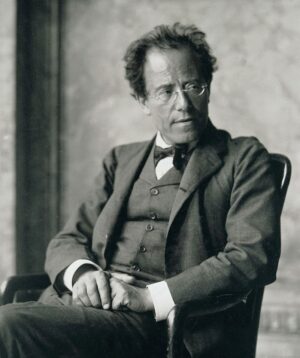
Austrian conductor and composer Gustav Mahler was an extremely superstitious man. Most famously, he renumbered his own symphonies in an attempt to avoid the infamous “curse of the ninth”, a superstition that presumes great composers (Beethoven, Schubert, Dvorak) will die after writing nine symphonies. But sadly this didn’t work out for Mahler; he died shortly after the completion of his own ninth symphony.
The massive hammer blows in Mahler’s Sixth Symphony are another example of his superstitious nature. At several points in the work’s concluding movement, Mahler asked for a sound that was “short, mighty, but dull in resonance, with a non-metallic character (like the stroke of an axe).” The so-called “Hammer of Fate” has become the Sixth Symphony’s most memorable feature, often more for the visual effect than for its actual sound, which can be difficult to realize according to Mahler’s ambiguous indications. At the work’s premiere, Mahler indicated three hammer blows, but later decided that this was bad luck. Afraid he was sealing his own fate with three hits (symbolizing completion), he revised the score to include only two strokes of the fateful hammer.
However, the revision may have been too late. Symphony No. 6 premiered in 1906, when Mahler’s career and health were outwardly strong. But the following year brought an almost unbelievable string of bad luck: his ouster as director of the Vienna Court Opera, the death of his daughter Maria, and his own diagnosis with a heart defect that would lead to his own death three years later.
Aside from his apparently-justified penchant for superstition, Mahler was also infamously indecisive, and the Sixth Symphony gave him one of his most vexing matters about which to waffle. Traditionally, the movements in symphonies follow a standard pattern: first movement fast, second movement slow, third movement dance, fourth movement fast. In a move that was common at the time, Mahler composed the dance movement (Scherzo) in the second place and the slow movement third. But at the last minute he reversed the order back to the standard practice, with the slow movement second and the Scherzo third. Thereafter the movement order became, like the “correct” number of hammer blows, another topic of endless musicological debate.
LISTENING GUIDE
First Movement: Allegro energico, ma non troppo
- Motive: Mahler uses a signature, military-like rhythm at several key moments throughout this symphony (particularly in the first and third movement). This is often echoed by another quintessential Mahler motive: a prominent, held major chord that “sours” into minor.
- Timbre: Mahler makes significant use of triangle, celesta, xylophone, and glockenspiel in this movement to highlight a number of colorful woodwind and string gestures.
- Timbre: Most uniquely, he uses “Herdenglocken” both on and off stage. These are “herder’s bells”, similar to modern cowbell, but employed here in a non-rhythmic manner to imitate the actual movements of an Alpine herd.
Second Movement: Andante moderato
- Texture: In the outer movements, Mahler often employs his large number of woodwind players as a kind of amplification system, with various melodic lines played in unison by four flutes, four oboes, etc. But in the inner movements, these parts often have divergent parts, creating a wide variety of textures.
- Melody: Listen for repeated usages of a simple, four-note melody: a leap up of a sixth, followed by the same leap downward.
Third Movement: Scherzo
- Harmony: Amid the somewhat harsh and forceful minor mode, Mahler makes a few smooth modulations into a friendlier major mode, as if he is trying to claw himself out of conflict. But his slides back into minor happen much more directly.
- Rhythm: Mahler brings in the divergent “Trio” music twice. To contrast the directness of the main Scherzo’s triple meter, these passages have frequent changes of time signature (3/8 and 4/8).
Fourth Movement: Finale
- Texture: Mahler begins this epic finale with cinematic flourishes in the celesta and harp, which herald the return of the forceful military rhythm in the timpani from the first movement.
- Rhythm: Though this movement has a fast tempo, Mahler will occasionally frustrate the sense of forward motion by writing fitful, quick solo lines offset by long-held notes where the beat is not directly articulated. This contributes to a sense of anxiety and anticipation.