

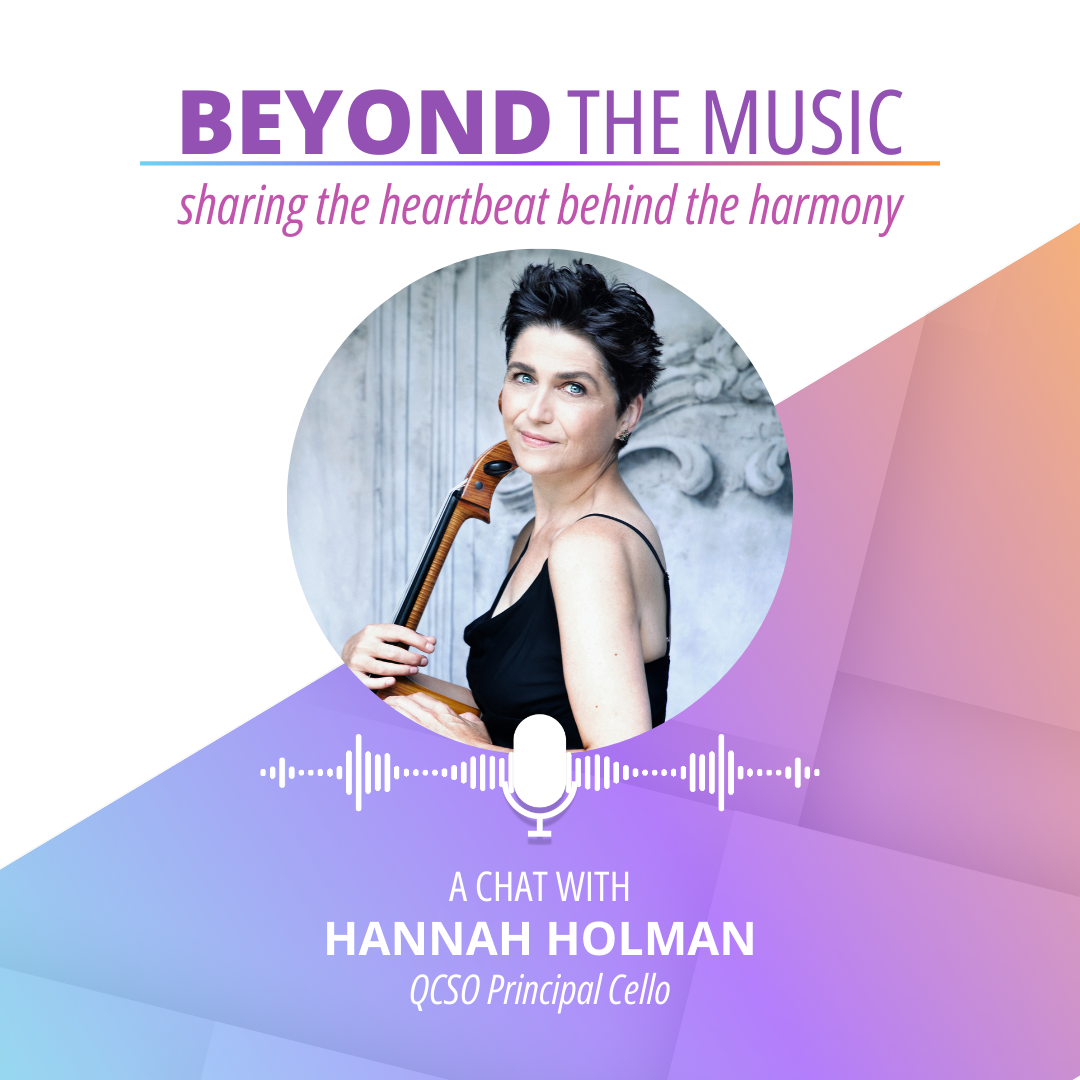
On this episode of Beyond the Music, QCSO Executive Director Brian Baxter sits down with Principal Cellist Hannah Holman, who will premiere a brand‑new cello concerto by composer Rebecca Burkhardt on Masterworks V: Beethoven Second Symphony on March 7 & 8.
Holman shares the story behind the creation of this deeply personal, three‑movement concerto—each movement inspired by one of the states she has called home: the wide‑open landscapes of Iowa, the industrial pulse and Motown energy of Detroit, and the vibrant artistic world of New York City. She discusses how Burkhardt wove history, identity, and place into the musical fabric of the work, crafting a concerto that is both tailor‑made for her and universally resonant.
The conversation also explores the rare opportunity to workshop the piece in advance with conductor Erik Rohde and the University of Northern Iowa Orchestra, allowing composer and soloist to refine the score together. Holman reflects on the emotional impact of the music, the challenge and joy of preparing a world premiere, and the meaningful decision to perform it on her family’s 100‑year‑old Carl Becker cello.
TRANSCRIPT:
Brian Baxter:
Welcome to Beyond the Music. I’m so pleased to be joined by Hannah Holman, our Quad City Symphony Orchestra Principal Cellist. Hannah, thanks for being here.
Hannah Holman:
Oh my gosh, I’m so happy to be here.
Brian:
We’re talking not only because you’re an awesome member of our orchestra, but because you’re being featured on our next Masterworks concert—Masterworks 5—which includes the world premiere of a new cello concerto by composer Rebecca Burkhardt. Tell us about this piece and what it’s like to work with a composer on a concerto.
Hannah:
First of all, I’m so grateful to you all for making this happen and giving me the opportunity to play a concerto. When it came time to choose a piece—my last concerto with the QCSO was Schelomo three or four years ago—I thought, Wouldn’t it be wonderful to play a concerto by a woman? But there just aren’t that many cello concertos by female composers.
A long time ago, Rebecca wrote a trio for my ensemble, Trio 826, called The Blues Triptych. It’s a fantastic piece. We were on tour in Brazil with the trio and the University of Northern Iowa orchestra, and I asked her then if she’d ever consider writing a concerto for me. She said yes—but that was almost ten years ago!
Fast‑forward to a couple of years ago when this opportunity came up again. I reached out and said, “Hey Becky, remember when you said you’d be open to this?” And she said yes. I’m so grateful she took it on. A full concerto is a huge project—very different in scope and orchestration from a string trio—and she created something truly special.
Brian:
And you were able to workshop it, right?
Hannah:
Yes! Rebecca had the piece essentially finished a year ago. Because of her ties to the University of Northern Iowa—and thanks to our former QCSO member Erik Rohde, who now conducts there—we were able to workshop the concerto last March with Erik conducting. That was such a gift. We got a recording, made some adjustments, and people who heard it were blown away. Several said, “I’m coming to the Quad Cities to hear this premiere.” So we may have folks traveling from all over Iowa and beyond.
Brian:
That’s fantastic. And it’s always exciting to present a world premiere—especially when you’ve had the chance to test‑drive the piece beforehand.
Hannah:
Absolutely. It makes such a difference.
Let me tell you a little about the piece. Rebecca asked me what matters to me as a musician, as a woman, and as a cellist—what music speaks to me. I told her that two of the greatest cello concertos, Elgar and Dvořák, give the cello a deeply personal voice, almost autobiographical for the composers. She really took that to heart.
The concerto is in three movements, each inspired by one of the three states I’ve lived in.
Movement I — Walking (Iowa)
Rebecca writes: “Walking conjures the cry of Indigenous ancestors who walked the plains of this country, the migration of settlers, the harshness of conflict between peoples, and the starkness of a life enveloped by wilderness in winter.”
The ending of this movement is chilling—she creates sounds and colors I’ve never heard from an orchestra before.
Movement II — Working (Michigan / Detroit)
This movement draws on Motown and the industrial soundscape I grew up around.
“Working begins with the day breaking into the howl of a factory whistle. Motives of the Motown sound mix with the low grind of factory mechanisms, ending in a continuously rising treble shout between the cello and the orchestra.”
I told her I wanted something tangible—something people could feel—and she delivered.
Movement III — Wandering (New York City / Harlem)
This movement reflects my life in New York.
“Wandering continues the exploration of dance in the performance wonderland of Manhattan. The sounds of early Harlem and Puerto Rican rhythms combine with classical balletic melodies to invoke the euphoria of success, the exasperation of inequality and failure, and a hope and wonder for what might come next.”
Even listening to the MIDI mock‑up, I get choked up. It’s incredibly moving. Bravo to Rebecca—she’s written a remarkable piece.
Brian:
It sounds extraordinary. And it’s wonderful to present two major world premieres by female composers on consecutive Masterworks concerts.
Hannah:
Yes! Go QCSO! These aren’t small pieces—they’re substantial works. I’m so proud of this programming.
Preparing a Concerto Performance
Brian:
Before we wrap up, what’s something you can share about preparing a concerto as the soloist?
Hannah:
Preparation is everything. When the composer is alive, it’s wonderful because you can check in and make sure you’re on the right track. After the workshop last March, I let the piece simmer, then brought it back during Nutcracker season.
Another big part of preparation is choosing the right instrument. The cello is your voice. I’ve been trying different instruments, and just this week I flew to Michigan on my day off to pick up my father’s cello—a 1926 Carl Becker made for my grandmother, who was also my first teacher. It hasn’t been played much in decades, but it’s beautiful. I used it in high school, and Mark Russell Smith and I have both played Beckers in chamber settings.
It feels meaningful to use it for this premiere—especially in its 100th anniversary year. My project this weekend is getting it sounding its absolute best.
Brian:
That’s incredibly special.
Last question: what’s one thing you wish people knew about the life of a professional musician?
Hannah:
Discipline. Every musician wears many hats—performer, teacher, collaborator—and you have to be disciplined with your practice, your schedule, everything. But equally important is finding the fun. If it’s only discipline, then what are we doing? You have to keep the joy alive.
Brian:
Absolutely. Well said.
Hannah, thank you so much for joining us on Beyond the Music. We can’t wait for your performance of Rebecca Burkhardt’s brand‑new concerto at our March Masterworks, alongside Bernstein and Beethoven—the three B’s: Bernstein, Burkhardt, and Beethoven.
Hannah:
My pleasure.
Beyond the Music: sharing the heartbeat behind the harmony
Beyond the Music: Sharing the Heartbeat behind the Harmony takes you behind the scenes of the Quad City Symphony Orchestra to meet the musicians, staff, and community members who bring the music to life.
Through candid conversations and personal stories, this series explores the passion, people, and purpose that drive every performance, giving you a deeper connection to the symphony and the harmony it creates both on and off the stage.